How Ancient Rome influenced Portuguese food
Roman expansion into the western Iberian Peninsula began in 218 BC, but taking control of the territory that is now Portugal was a long process. Several peoples lived here at the time, including the Lusitanians, who resisted Roman expansion for decades. The Lusitanian Wars of the 2nd century BC are particularly associated with Viriathus, the leader who became one of Rome’s most persistent opponents in the region. Under Emperor Augustus, Lusitania became a Roman province in 27 BC, covering most of present-day Portugal south of the Douro as well as parts of western Spain. Roman rule lasted here for several centuries, until around the beginning of the 5th century AD.
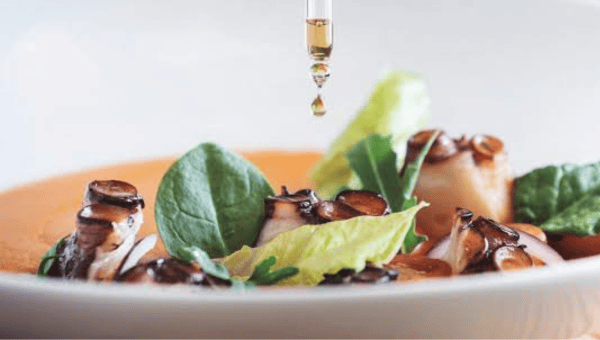
Featured photo by Selo de Mar
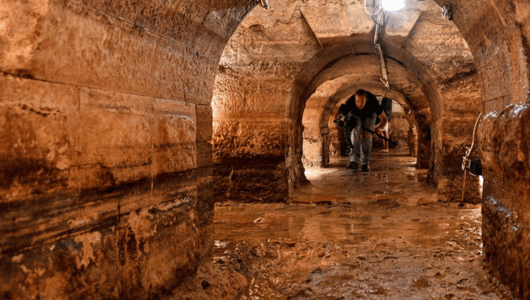
Photo by VxMag
Lisbon was then Olisipo, an important port city connected to a much wider Roman world. Across the territory, cities, roads and ports developed under Roman rule, and traces of them are still being uncovered today. In Lisbon, you can get a glimpse of this past at the Roman Theatre and its museum (Rua de São Mamede 3A), or underground at the Archaeological Center of Rua dos Correeiros (Rua dos Correeiros 9), where remains spanning several periods of the city’s history include structures from Roman Olisipo. During their limited annual openings, you can even descend into the Roman Galleries beneath Rua da Prata. Elsewhere beneath the modern city, archaeologists have also uncovered fish-processing facilities closer to the Tagus.
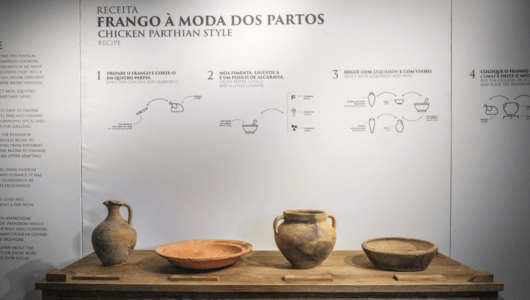
Photo by Fundação Millennium bcp
Many of the ingredients we strongly associate with Portugal today, including wine, olive oil, cereals, fish, legumes and pork, were already known in Iberia before the Romans arrived. But Rome certainly influenced how food was cultivated, processed, preserved, transported and traded on a much larger scale. Two thousand years later, many of those ingredients are still staples of the Portuguese pantry, even if the Roman connection is harder to recognize in individual dishes. Later influences, particularly the Moorish influence on Portuguese food, are easier to recognize in today’s dishes, while the Roman impact is more visible in agriculture, food production and trade.
Food and agriculture in Roman Portugal
Roman rule changed the scale and organization of food production and trade in Lusitania. Agriculture was already central to life in the region, but under Roman rule it became part of a much broader economic system. Large villae existed alongside smaller farms and rural settlements, producing food for their own needs, nearby towns and, in some cases, wider commercial networks. Fields, orchards and vegetable gardens existed alongside presses, tanks and storage facilities used to process and store crops.
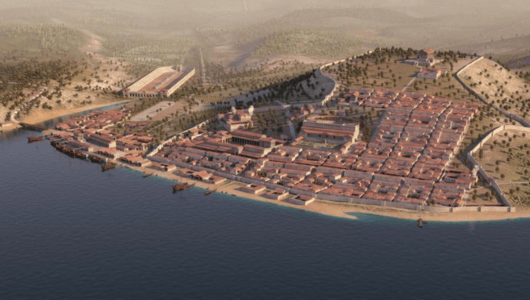
Photo by e-cultura
Roman roads connected settlements across the territory, and rivers and Atlantic ports allowed food and other goods to move between Lusitania, the rest of Hispania and the wider Mediterranean. Olisipo, represented in the image above, and corresponding to present-day Lisbon, became an important maritime trading center, and archaeological finds show connections across the Roman world. Rural production supplied nearby towns and cities and also entered wider trade networks. Many smaller communities, however, still depended heavily on food produced and consumed locally.

Photo by Centro de Arqueologia de Lisboa on Facebook
Large ceramic containers known as amphorae were used to store and transport food and drink, and the fragments archaeologists uncover today can help identify where products came from and how far they traveled. In the Tagus estuary, archaeologists have also found ovens where amphorae were made and fired, showing that producing food, preparing it for transport and getting it to market were all connected activities which started being done at an unprecedented scale.
Olive oil in Roman Portugal
Under Roman rule, olive cultivation and oil production became increasingly organized in Lusitania, particularly in the south, where rural estates had presses and storage facilities. These estates generally combined several agricultural activities, so olives could be grown alongside vines, cereals and other crops.
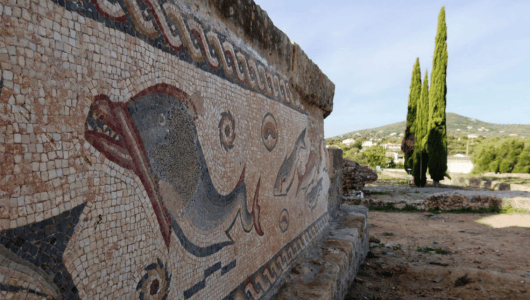
Photo by Bilheteira Património Cultural
Some of this can still be seen at Roman archaeological sites in Portugal. The Roman villa of Milreu (pictured above), near Faro, had facilities for producing both olive oil and wine, along with the residential buildings, baths and elaborate mosaics that belonged to a wealthy rural estate. Similar evidence of pressing has been found at other villae, suggesting that olive oil production supplied the people living on the estates and also reached nearby markets.
Lusitania never produced olive oil on the extraordinary scale seen next door in Baetica, the Roman province covering much of present-day Andalusia. Baetican oil traveled in huge quantities across the empire, including into Lusitania, and its characteristic amphorae have been found throughout Roman territories. People in Lusitania consumed locally produced oil as well as oil imported from Baetica.
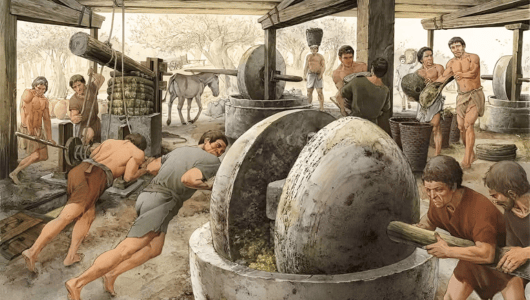
Image by Roman World on Facebook
Olive oil had many uses in everyday Roman life and, besides being used in cooking and food preservation, it also fueled lamps and was used in cosmetics and personal care products. Its importance helped establish olive cultivation for centuries, and today olive oil is still one of the most important ingredients in Portuguese cooking.
In Bobadela, near Oliveira do Hospital, the Museu do Azeite was built above the remains of an ancient Roman town and traces olive oil production from Roman times to the present day. The exhibition includes reconstructions of historical olive presses and explains how olives were harvested, pressed and decanted over the centuries. Visitors can see reconstructed historical presses, taste olive oil at the museum’s Olea restaurant and buy oil produced in its own mill.
How the Romans changed wine production in Portugal
By the time Roman rule was established in western Iberia, wine was already being made here, but production grew considerably from the 1st century AD onwards. Vineyards spread across much of what is now Portugal, rural estates developed presses and wine-storage areas, and locally produced wine became increasingly important. During the Roman conquest, much of the wine consumed by soldiers had arrived from Italy but, by the 2nd and 3rd centuries CE, locally and regionally produced wines had already become more common.
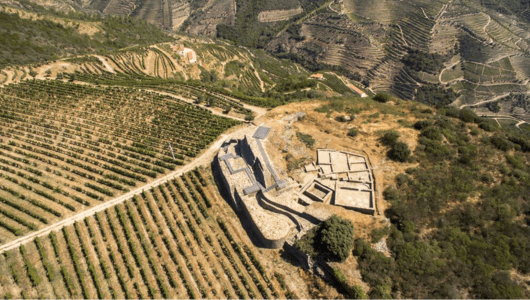
Photo by Câmara Municipal Peso da Régua
Roman winemaking took place across what is now Portugal, using presses, cellars, large ceramic storage vessels and, in some places, basins carved directly into rock for crushing grapes. Wine production also reached areas that are now among Portugal’s major wine regions. At Alto da Fonte do Milho, near Peso da Régua in the Douro Valley, archaeologists found a Roman rural estate (pictured above), with facilities used for pressing grapes.
In the Alentejo, vinho de talha preserves a winemaking technique associated with Roman times, although by the 20th century it had become increasingly rare. The spread of cooperative wineries, stainless steel tanks and more standardized production pushed aside traditional clay-vessel winemaking, surviving mainly in family cellars. Interest returned in recent decades as producers began recovering older methods and drinkers became more curious about traditional and low-intervention wines.
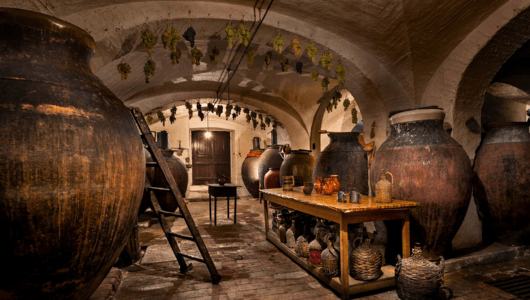
Photo by Portugal By Wine
Vinho de talha ferments in large clay vessels known as talhas. Grapes are crushed and placed inside, and the juice ferments in contact with the skins and other solid parts of the fruit. As these solids settle, they can act as a natural filter when the wine is drawn from an opening near the bottom. Because clay is porous, the inside of the talha is traditionally coated with pez, a preparation based on pine resin that makes it watertight.
The Alentejo is still the main region for vinho de talha, particularly around Saint Martin’s Day on November 11, when many producers and taverns open the new season’s wine during the abertura das talhas. The production of vinho de talha was added to Portugal’s National Inventory of Intangible Cultural Heritage in 2023, recognition of a technique that has survived largely through small producers.
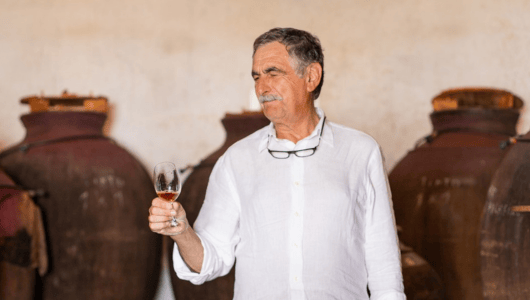
Photo by Turismo do Alentejo
In Lisbon, restaurant O Frade (Calçada da Ajuda 14) serves its own red and white vinho de talha, produced in Vila de Frades in the Alentejo, where the Frade family has a long tradition of making wine in clay vessels. Among Lisbon’s wine bars, Black Sheep in Praça das Flores is another place worth checking, particularly for wines from small independent Portuguese producers. Its selection changes frequently, but talha wines and producers such as Gerações da Talha have featured there. To buy a bottle, Garrafeira Nacional (Rua de Santa Justa 18 and Rua da Conceição 20) carries several vinhos de talha from Alentejo producers, including Talha de Frades, Honrado Vineyards, Herdade do Rocim and Adega Marel. At Adega José de Sousa in Reguengos de Monsaraz, a traditional cellar contains 114 clay talhas still used for winemaking, and guided visits include tastings of the wines produced in them.
How cereals fed Roman Portugal
Long before Roman conquest, people living in the territory that is now Portugal were already growing wheat, barley and millet, alongside older hulled wheats such as spelt and emmer. They also relied on foods gathered from the surrounding landscape. Acorns were particularly important in parts of the north and interior, where they were dried, ground into flour and used to make a dense bread that could be stored for long periods. Roman writers tended to associate this reliance on acorns and other gathered foods with a less developed way of life, partly because Roman ideas of agriculture placed greater value on cultivated cereals. Today in Portugal, acorns are much more closely associated with feeding free-ranging Iberian black pigs (porco preto) than with feeding people, although projects such as Freixo do Meio are bringing them back into the kitchen as part of their efforts to recover local foods and use more of what Portugal’s traditional oak woodlands naturally produce.
Under Roman rule, naked wheats, broadly related to the bread and durum wheats we know today, and hulled barley became the dominant cereals across much of Lusitania. Millet continued to have greater importance in the north, and regional differences were considerable. In northwestern Portugal, spelt and other hulled wheats had been especially important during the Iron Age and gradually lost ground during the Roman period. Ancient farms, such as those in the area of Quinta de Crestelos, near Mogadouro, show that some farms were storing grain well beyond the immediate needs of a household.
Rye also started appearing in northern Portugal around the time of the first contacts with Rome. Some of the earliest rye found anywhere in the Iberian Peninsula comes from northwestern sites dating between the 3rd and 1st centuries BC, including Crastoeiro near Mondim de Basto. At first it may have grown as a weed among crops such as spelt, and clear evidence of rye being deliberately cultivated became more common during the later Roman period. Its tolerance for colder weather, poorer soils and less favorable growing conditions eventually made it particularly valuable across the mountainous north and interior. Rye suited the colder climate and poorer soils of Trás-os-Montes particularly well, and dense pão de centeio, is still one of the region’s characteristic breads Traditional producers such as Pão de Gimonde continue to make rye bread using sourdough, wood-fired ovens and flour milled locally, part of the tradition of Portuguese sourdough and artisanal bread.
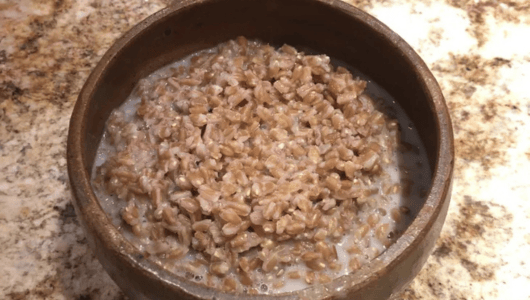
Photo by Cibi Antiquorum
Whatever grain was cultivated, it eventually had to pass between millstones. Rotary hand mills made from two circular stones became common, and larger milling systems allowed greater quantities of flour to be produced. Flour went into bread and other cereal preparations such as porridges, although there is no single “Roman Portuguese bread” that we can reconstruct and connect directly to a loaf sold today. The bigger change was the growing scale at which grain could be cultivated, stored, milled and moved between farms and towns.
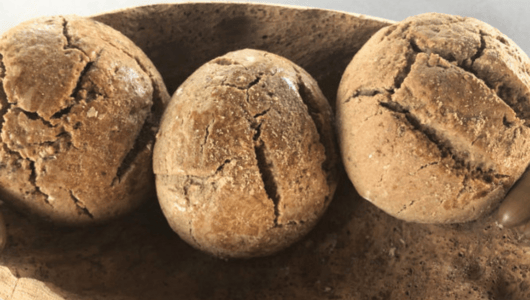
Photo by Freixo do Meio
Acorn bread has also returned to Portuguese food, even if it is within small-scale projects. At Freixo do Meio, near Montemor-o-Novo, acorns from the surrounding oak woodland are processed into flour and used for bread, biscuits and other foods. Its traditional bakery makes pão de bolota (pictured above) in a wood-fired oven, and visitors can buy the bread and acorn flour at the estate shop. The food-production facilities, including the acorn-processing unit and bakery, can also be visited.
In Lisbon, Gleba, one of the city’s best artisanal bakeries, works with Portuguese-grown grains, mills its own flour between stone millstones and uses long natural fermentation. Its Barbela loaf is made with an old Portuguese wheat variety that almost disappeared as higher-yielding commercial wheat took over, and the bakery also works with varieties such as Roxo, Azul, Valbona and Galera. Several of its stone-ground flours are sold separately too, so home bakers can experiment with these traditional varieties themselves.
Traditional milling can also be seen at the Moinho do Papel in Leiria, where water power still drives the grinding of wheat, rye and other cereals. The mill dates from 1411 rather than Roman times, but visitors can watch grain being ground and buy the flour produced there. It is a much later piece of Portuguese food history but, for those curious, the operation of grain passing between stones would have been similar to the one in Roman Lusitania.
Salt and food preservation in Portugal during the times of the Roman Empire
Salt was indispensable to the Roman food system because it extended the life of ingredients in the times before refrigeration. Meat could be salted or cured, and brine was used to preserve foods such as olives and cheese. Along the coast of Lusitania, demand was particularly high because salt also supplied the large food-processing businesses that developed around the Tagus and Sado estuaries and in the Algarve (more on this below).
Sea salt was produced by moving seawater through a series of shallow ponds and gradually increasing its concentration until crystals formed. Sun and wind provided most of the work, and channels, gates and gravity controlled the movement of the water. Traditional Portuguese saltworks still use the same basic methods today. At the Salinas do Samouco, across the Tagus from Lisbon in Alcochete, estuary water passes from a reservoir through several evaporation ponds before reaching the shallow crystallization basins where the salt is collected.
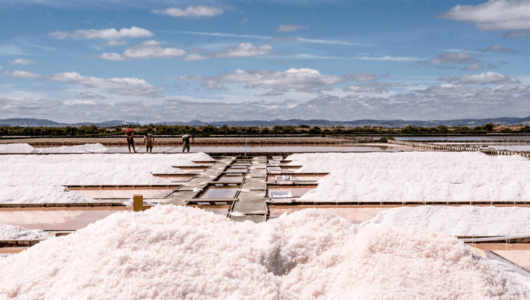
Photo by Salinas do Samouco
The Samouco complex once contained 56 saltworks and formed part of an industry that made the Tagus one of Portugal’s major salt-producing areas. Today only the Marinha do Canto still produces salt there using traditional methods. Preparation of the ponds begins in spring, the first harvest generally takes place in June, and production continues until around September. The salt is gathered manually with traditional tools, and the delicate crystals that form on the surface are collected separately as flor de sal. Visitors can walk through the saltworks, learn how the different ponds function and buy the salt produced there.
Portugal’s long history of salt production also includes an unusual inland source at the Salinas da Fonte da Bica, near Rio Maior. Around 30 kilometers from the Atlantic, underground water passes through deposits of rock salt beneath the Serra dos Candeeiros before reaching the surface. The resulting water contains around seven times as much salt as seawater and is distributed through shallow pans to evaporate in the sun. Salt extraction here is associated with Roman times, it was later managed by the Templars, and by the 15th century, King Afonso V himself owned several plots.
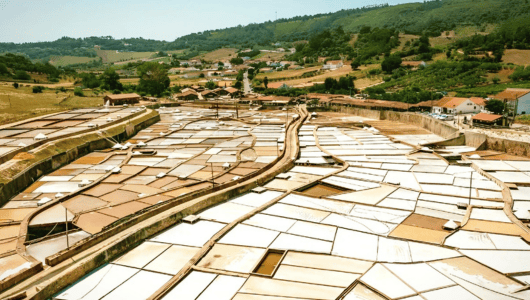
Photo by Portugal.fr
Rio Maior still produces salt with very little mechanization and the local cooperative, created in 1979, has deliberately maintained artisanal methods, so the salt continues to be stored in the characteristic wooden buildings surrounding the pans. Visitors can walk among the salt pans, watch a process still based largely on water, sun and manual labor, and buy the salt produced there.
Portuguese still carries this Roman connection in the word salário, inherited from the Latin salarium, a term related to sal, meaning salt. The English word salary comes from the same Latin word. This has helped popularize the story that Roman soldiers were literally paid in salt, although there is no solid evidence that this was a regular practice. The connection between salt and the word for wages is real, but the idea of soldiers receiving salt as their literal paycheck is probably an oversimplification.
Fish salting and garum during Roman rule in Portugal
Along the Atlantic coast and the Tagus and Sado estuaries, Roman producers had access to sardines, mackerel, horse mackerel, anchovies and many other species in abundance. Salting and fermenting the catch allowed it to last far longer than fresh fish and made it possible to transport these products in amphorae to other parts of the empire. By the height of Roman rule, fish processing had become an important industry in Lusitania so local resources became a big export for the wider markets across the empire.
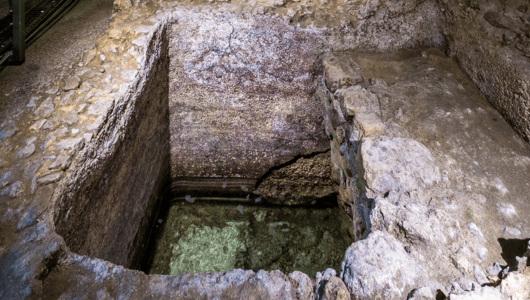
Photo by Toponímia de Lisboa
In Olisipo, much of this activity took place close to the riverfront, including in areas around today’s Baixa and Alfama. Workshops contained large rectangular tanks known as cetariae, where fish could be salted or fermented, and sardines were among the species processed in greatest quantities, alongside mackerel, horse mackerel, anchovies and other local small fish. Four Roman processing tanks can still be seen at the Casa dos Bicos (pictured above), a few steps from the Tagus. The recipes changed enormously over the following two thousand years, but Lisbon’s close relationship with sardines clearly started long before today’s summer grills and Saint Anthony festivities.
Across the Sado from what is today Setúbal, Tróia became one of the largest Roman fish-processing centers in the western empire, with almost 200 tanks spread across the archaeological complex. Its location gave producers easy access to fish, salt and maritime trade routes, creating ideal conditions for producing preserved fish on a large scale. Travelers can visit the ruins today and see the tanks where those products were once prepared before being packed and shipped elsewhere.
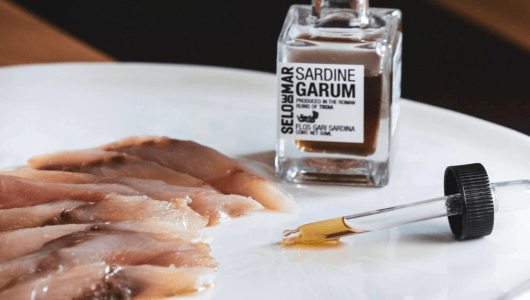
Photo by Selo de Mar
Part of the catch was preserved as salted fish, known broadly as salsamenta, and another part was turned into fermented sauces such as garum. Fish or fish parts were mixed with generous quantities of salt and left to ferment until they broke down into a concentrated savory liquid. Romans used it in small amounts to season meat, vegetables, fish and sauces, adding both saltiness and the deep savory character known today as umami. The Thai fish sauce nam pla is probably the easiest modern comparison, although Roman garum would vary in ingredients, quality and price.
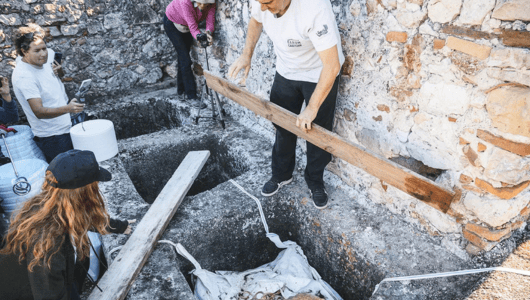
Photo by Selo de Mar
Garum has also returned to Portuguese kitchens in recent years. In 2021, Selo de Mar worked with the Roman Ruins of Tróia and researchers to produce it inside one of Tróia’s original Roman tanks, using sardines from Setúbal and salt from the Sado Valley. They let the mixture ferment for several months and follow modern food-safety requirements, producing different garums using Portuguese seafood such as sardine, mackerel, horse mackerel, tuna and grouper. Chefs then use garum to add depth of flavor to their dishes, but they only need really small amounts, as it’s pungent and packed with intense taste.
In 2024, this garum revival inspired the À Mesa com os Romanos gastronomic week, during which 26 restaurants across the Lisbon region created dishes inspired by Roman food. The Museu de Lisboa – Teatro Romano has also explored Roman cooking through occasional food events. In June 2026, for example, chef Maria Caldeira prepared a Roman-inspired dinner there that included duck with roasted chestnuts and garum, as well as moretum, a rustic spread made with cheese, herbs, garlic and olive oil, served with bread.
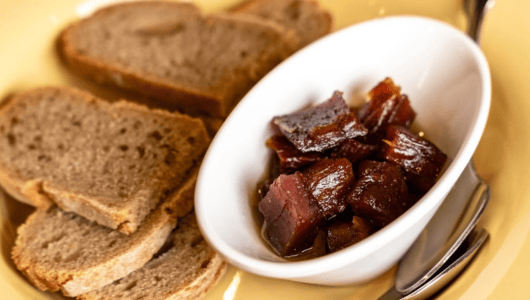
Photo by Taberna do Mar on Facebook
In Graça, the team behind A Taberna do Mar (Calçada da Graça 20B) also runs Garum Fish & Wine from the same address, with a menu focused on fermented fish products and seafood. Selo de Mar in Setúbal combines a seafood restaurant with a garum shop, where several versions can be tasted and bought, and its bottles are also available at selected shops in Lisbon (see their website to check addresses).
It’s important to note that the fish being salt-cured in Roman Lusitania was not cod. Bacalhau came into Portuguese food culture much later, with Portuguese fishing expeditions to the North Atlantic around the late 15th and early 16th centuries. What does connect the two stories is the preservation technique itself. Salting fish was already well established here under Roman rule, and centuries later that same basic method became central to Portugal’s long relationship with bacalhau. The species changed completely but the idea of using salt to preserve fish for storage and transport did not.
Pork, sausages and meat preservation under Roman rule in Portugal
People in Roman Lusitania ate pork, sheep, goat and beef, in different proportions depending on what could be raised locally and how animals were used. Cattle were valuable for agricultural work as well as meat, and sheep and goats provided milk, wool and meat. Pigs were particularly useful because so much of the animal could be eaten and preserved. Salting, drying and smoking extended the life of the meat, an important advantage when slaughtering was seasonal and fresh meat could not be kept for long.
Hunting added another source of meat, especially outside the larger towns, and deer, wild boar, rabbit and hare were eaten in different parts of Iberia, continuing practices that predated Roman conquest. Roman agriculture increased the importance of managed livestock and commercial food production, but meat consumption still reflected local landscapes and access to animals rather than one uniform diet across the province.
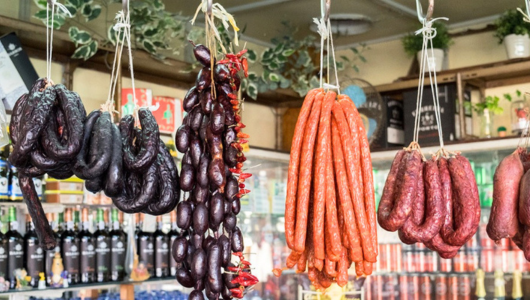
Photo by Portugal Nosso
Sausage-making was already highly developed in the Roman world, using many of the same basic techniques that define Portuguese cured meats (enchidos) today. Meat and fat could be chopped, seasoned, packed into animal intestines and then smoked, dried or cooked. One preparation described in Roman culinary texts was lucanica, a sausage associated with Lucania in southern Italy. A surviving recipe attributed to Apicius seasons chopped meat with pepper, cumin, herbs and other aromatics before stuffing it into a casing and smoking it. The ingredients would taste quite different from a Portuguese sausage today, but the preparation itself is immediately recognizable.
The Portuguese word linguiça is also linked etymologically to Latin lucanica. The Latin name gave rise to several sausage terms around southern Europe, including Italian luganega, Spanish longaniza and, through centuries of linguistic change, Portuguese linguiça. This does not mean that the modern Portuguese sausage follows a Roman recipe. Garlic, wine and regional smoking traditions developed their own characteristics here, and ingredients now strongly associated with Portuguese enchidos, particularly paprika and red pepper paste, only became possible after peppers arrived from the Americas several centuries later.
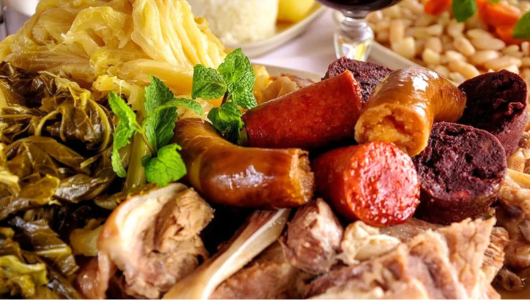
Photo by Ruralea
Over the centuries, Portuguese sausage-making developed into the wide range of enchidos eaten today, from linguiça and chouriço to paio, salpicão and morcela. Trás-os-Montes is especially known for smoked sausages, and the Alentejo has a strong tradition of pork products linked to Iberian black pigs. These cured meats are still central to dishes such as cozido à portuguesa, where several cuts of meat and different enchidos are cooked together with vegetables.
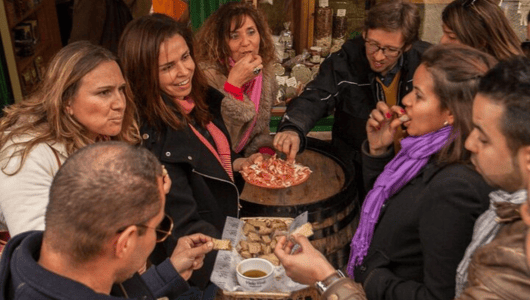
Photo by Taste of Lisboa
In Lisbon, Manteigaria Silva (Rua D. Antão de Almada 1C) is a good place to browse and buy Portuguese enchidos from different parts of the country. The same historic delicatessen also has a stand at Time Out Market (Mercado da Ribeira, Av. 24 de Julho), where you can sit down with a platter of cured meats and Portuguese cheeses, bread and local wine. Manteigaria Silva is also one of the stops on our Lisbon Roots – Food & Cultural Walk, where we taste some of these products and explore Lisbon’s traditional food culture. O Frade in Belém, which we already suggested above for vinho de talha, covers both enchidos and wines made in clay vessels. Traditional restaurants and tascas across Lisbon also commonly serve chouriço assado, cooked over a small flame at the table, and bakeries sell pão com chouriço, with sausage baked directly into bread. Neither is a Roman dish as such, but both use preserved pork in ways that connect with techniques already familiar in this territory around two thousand years ago.
Legumes and vegetables in Roman-era Portugal
Roman Lusitanian gardens produced herbs, vegetables and legumes, with broad beans (favas) being the most common, alongside peas, lentils, grass peas (chícharos) and bitter vetch (ervilhas-de-pombo). This pantry looked quite different from the one we now associate with Portuguese cooking as, most of the white, red and black beans commonly used today belong to the species Phaseolus vulgaris, which only reached Portugal from the Americas during the 16th century.
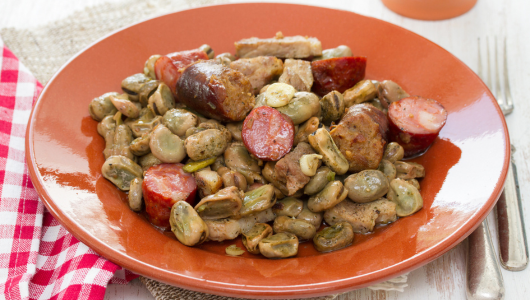
Photo by Terras do Demo
Broad beans have a much longer history here than the common beans used in dishes such as feijoada or arroz de feijão. Today, favas guisadas à portuguesa combine broad beans with smaller amounts of pork, ribs or enchidos, and simpler recipes appear when fresh favas come into season in spring. In the Azores, favas com cebolada are cooked with plenty of onion and can be entirely plant-based. These dishes are not Roman recipes, but broad beans themselves have been part of the local diet for thousands of years. Portuguese bean and fava dishes show how much the country’s pulse repertoire expanded after ingredients from the Americas joined these older varieties.
Until well into the 20th century, and particularly during the dictatorship which lasted until 1974, many Portuguese families ate mainly bread, cereals, potatoes, vegetables and pulses. Meat and fish appeared in smaller quantities because they were more expensive, and a little pork, sausage or fish could flavor a pot shared by the whole family. Similar eating habits developed across the Mediterranean, including Spain, southern France and Italy, where cereals, pulses, vegetables and olive oil supplied most of the everyday diet. These regions shared crops and food traditions way before modern national borders existed, and centuries inside the Roman Empire increased the circulation of ingredients, farming practices and preservation techniques between them. Lusitania developed particularly important industries around Atlantic fish and salt, but much of its everyday food belonged to this broader Mediterranean world. That older style of cooking is linked with many naturally plant-based traditional Portuguese dishes still found today, even though nobody preparing them centuries ago would have thought of them as vegetarian or vegan.
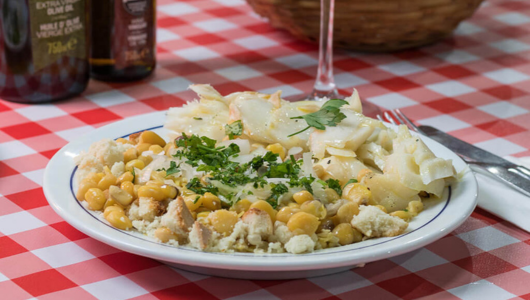
Photo by Festival O Chícharo da Serra
Favas, peas and lentils are still widely available in Portugal, but grass peas (chícharos) have become much more regional, particularly in central Portugal. In Alvaiázere, they are celebrated with an annual gastronomic festival dedicated to the chícharo, where dishes include migas de chícharo. O Chícharo da Serra, held in Santa Catarina da Serra near Leiria, also serves the pulse in recipes such as chícharos com bacalhau. Bitter vetch (ervilha-de-pombo, Vicia ervilia), another pulse eaten in Lusitania, has almost disappeared from the modern Portuguese kitchen. Lupin beans (tremoços), however, are still extremely common. Sold cooked and preserved in brine in virtually every Portuguese supermarket, they are one of the country’s cheapest and most familiar snacks, particularly with a cold beer. More recently, tremoços have also started appearing beyond the traditional petisco, including in products such as lupin flour to prepare other foods.
In Lisbon, to find less standardized pulses and regional varieties we recommend shops that aren’t regular supermarkets. Farmer Fernando Pires, for example, is a regular at Príncipe Real’s organic farmers’ market, held every Saturday morning, where among other things he sells a selection of pulses that change throughout the year. Pérola do Arsenal (Rua do Arsenal 94), one of Lisbon’s most iconic traditional grocery stores, is another place worth checking for unusual dried pulses.
Two thousand years later, the Roman influence on Portuguese food is easier to recognize in ingredients, techniques and food production than in individual recipes. Olive oil, wine, cereals, pulses, pork, fish and salt were already part of life in this territory, but Roman rule greatly expanded how many of them were cultivated, preserved, processed and traded. Portuguese cooking continued to evolve after the empire disappeared, absorbing major influences from the Moorish period and, centuries later, ingredients brought from the Americas. During centuries, everyday cooking depended heavily on local crops, grains, pulses and vegetables, often using smaller amounts of meat or fish for flavor. The dishes we eat today are the result of all these influences, not the direct survival of Roman recipes.
To taste some of these ingredients and traditions in Lisbon, join one of our Lisbon food and cultural walks and explore the city through its food history.
Feed your curiosity on Portuguese food culture:
Alfama vs Mouraria: what to choose in the two most ancient Lisbon neighborhoods
How to choose the right food tour in Lisbon for your travel style
Portuguese foods inherited from the Moorish occupation
The ultimate guide to olive oil in Portugal
Real people, real food. Come with us to where the locals go.
Signup for our natively curated food & cultural experiences.
Follow us for more at Instagram, Twitter e Youtube