
Beyond grilled sardines: other ways to eat sardines in Portugal

The smell of grilled sardines announces the arrival of summer in Portugal. In Lisbon, this fish has become synonymous with the popular June festivities that celebrate St. Anthony and a visual symbol that you’ll see time and time again printed on all sorts of souvenirs, from traditional ceramics to more contemporary t-shirts.
Feat photo by Lena Mattar
Portuguese people tend to love sardines, especially in the shape of sardinhas assadas. This recipe features the fish grilled over charcoal, seasoned simply with coarse salt, and either served with sides of boiled potatoes and roasted bell peppers salad if you’re sitting down for a meal, or atop a thick slice of bread if you’re grabbing them as a seasonal street food.
Sardines are so embedded in Portuguese culture because, for centuries, they were an affordable and abundant food for fishermen, dockworkers, and working-class families. Historically speaking, sardines were and still are a popular and fairly democratic fish option.
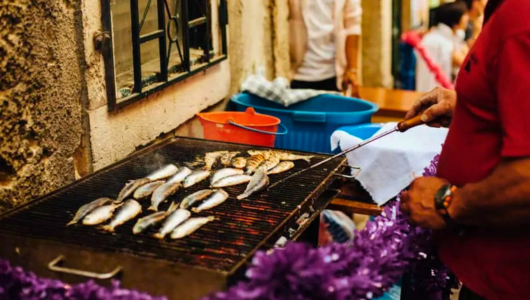
Photo by IATI Seguros
Grilled sardines exist across the country, but in Lisbon they have acquired a particular symbolic weight. Every June, during the Santos Populares, especially the festivities around Santo António on the night of June 12 and the day of June 13, you’ll come across outdoor grills in the most traditional Lisbon neighborhoods where the parties take place, such as Alfama, Mouraria, Graça, Bica and Madragoa. Even though the festivities have a religious background and lots of popular celebrations, they have become so associated with street food that, for many visitors, Santo António is often described as Lisbon’s “Sardine Festival”.
The association between sardines and summer has to do with the fact that this is a seasonal fish. During summer, sardines become fuller, fattier and more flavorful. Although they may begin appearing on grills earlier in the season, many locals will tell you that the best sardines often come later, once the fish has had time to gain fat. This matters because a good grilled sardine depends on that natural richness. The fish is small, but when it is in peak condition, the flesh is moist, the skin chars beautifully and there is fat enough to drop once you place your sardine on bread. When sardines are at their best, all you need is charcoal and salt.
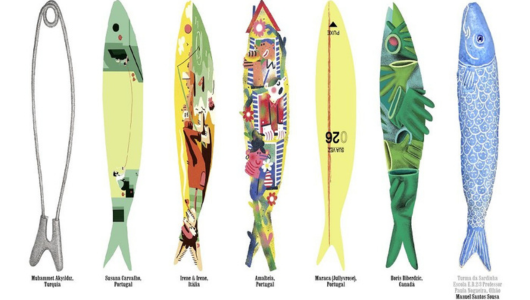
Photo by EGEAC
Beyond the table, sardines became meaningful when in 2003, the design studio Silvadesigners created the stylized sardine that became an identifying image for the Lisbon festivities, and since 2011 the city’s official sardines have been selected through an open design competition promoted by EGEAC, inviting artists and the general public to reinterpret the same simple fish silhouette year after year. The result is that the sardine became one of Lisbon’s most recognizable contemporary symbols, being adaptable and very easy to print on almost anything. This helps explain why visitors see sardines everywhere in Lisbon. Not just on menus, but on postcards, aprons, magnets, tiles, socks, tote bags and every possible kind of souvenir.

Photo by Felicidade Enlatada
If you’re thinking about edible souvenirs from Lisbon, sardine tins are one of the first things that come to mind. Portugal’s fish canning industry developed strongly from the 19th century onwards, with early production linked to places such as Vila Real de Santo António, Setúbal and, later, the northern canning hubs around Matosinhos and Leixões. As this industry grew, canned sardines and other types of practical seafood preserves not only became common staples in the Portuguese pantry, they also became a marker of Portuguese food identity.
Most visitors to Portugal associate sardines almost exclusively with the grilled version. But this fish has a much wider repertoire, and some of the best ways to eat it in Lisbon rarely make it onto tourist radar. Here are other ways to eat sardines we hope you get to try on your next trip to Portugal:
Sardine paté
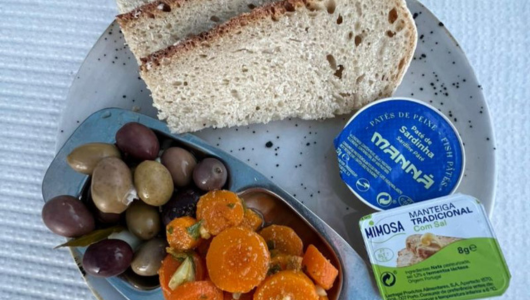
Photo by Tomorrow Magazine
Sardine pâté is the kind of thing you may find on a Portuguese restaurant table even if you did not specifically order it. In many traditional restaurants and simpler tascas, it appears as part of the couvert, the small selection of items brought to the table at the beginning of the meal. This usually includes bread, butter, olives, sometimes cheese, and one or two packaged spreads, most commonly tuna pâté or paté de sardinha. It is not exactly a free welcome snack, but more of a suggestion to keep you entertained while the kitchen prepares your food, and you are charged only for the items you actually open or eat.
In this context, sardine pâté usually comes in single-serve sealed packets, as it is not made in-house. The texture is smooth and spreadable, softer and more uniform than a homemade pâté, with the flavor of canned sardines with seasonings like tomato. Sardine pâté is usually enjoyed with bread or crackers.
At home, sardine pâté can be much better than the packaged version. It is also one of the easiest ways to turn a tin of sardines into something a little more elaborate you can serve with drinks. Drain one tin of sardines in olive oil, mash it with a fork, then mix it with one or two spoonfuls of mayonnaise, add a squeeze of lemon, a little mustard if you like, black pepper, and finely chopped parsley, onion or pickles. For a more old-school Portuguese snack-bar flavor, use sardines in tomato sauce instead of sardines in olive oil, or add a small spoonful of tomato paste and a few drops of piri-piri. A good sardine pâté will have a nice balance between the fattiness of the fish and something sharper or more acidic.
If you are in Portugal, you can find sardine pâté in any given supermarket but, while in the capital, we would recommend looking for good brands at some of the most iconic traditional groceries in Lisbon. While abroad, you can order Portuguese sardine pâté in specialty food shops online which deliver worldwide, such as A Vida Portuguesa, The Fantastic World of the Portuguese Sardine or Portugalia Marketplace.
Canned sardines
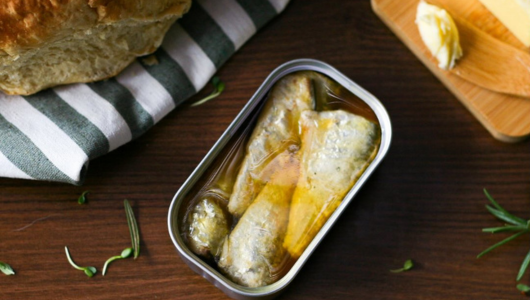
Photo by Fui ao Mar
Portugal’s canning industry began developing seriously in the second half of the 19th century, initially concentrated in the Algarve and the Setúbal peninsula, where sardine fishing was already a major part of local economies. As the industry grew and industrialized, production expanded north, with Matosinhos, just outside Porto, eventually becoming one of the most important canning hubs in the country. At its peak in the early 20th century, Portugal was one of the largest exporters of canned sardines in the world, supplying markets across Europe and beyond.
This started as a practical solution to preserve a highly perishable fish but, over time, it became very relevant. Even the tins themselves evolved into objects of design, colorfully stacked in beautiful arrangements in the shop windows of conserveiras that have been selling the same products for decades. In Lisbon, shops like Conserveira de Lisboa (Rua dos Bacalhoeiros 34) in Baixa, open since 1930, or the more contemporary The Fantastic World of Portuguese Sardines (Praça Dom Pedro IV 39), have turned the canned sardine into one of the city’s most distinctive edible souvenirs. You buy a tin not just for the sardines inside but for the illustration on the lid.
Designs aside, canned sardines come in different flavor varieties. Sardines in olive oil are the standard, with the oil acting both as preservative and flavor enhancer. Just like it usually happens with tuna as well, there are also sardines in sunflower oil, which are milder and a little cheaper. Other options include sardines in tomato sauce, which have a sweeter, more acidic profile and work particularly well eaten directly on bread; and sardines in spiced sauces, which vary by brand and can include lemon, garlic, chilli, or combinations of all three. Some producers also sell sardines in escabeche, which is a vinegary marinade, even thoughescabeche de sardinha is best when made fresh (see below).
In Portugal, eating sardines straight from the tin is a legitimate way to eat, it’s not considered a compromise or something you do only to save time or money. A growing number of restaurants and wine bars in Lisbon serve canned fish as a proper menu item, and this makes a great snack along with bread and a glass of wine. Places like Sol e Pesca (Rua Nova do Carvalho 44) in Cais do Sodré, a former fishing tackle shop converted into a canned fish restaurant, built an entire concept around this idea and helped shift the perception of conservas from convenience food to something worth sitting down for.
At home in Portugal, the most classic way to eat canned sardines is with boiled potatoes, a drizzle of olive oil, and a splash of vinegar. A hard-boiled egg and a little salad can also make it to the plate for a meal that is super quick to make, is complete from a nutritional point of view and feels very Portuguese in terms of flavors. You can also use tinned sardines to make salads, Portuguese style rice dishes (see arroz de sardinhas below) and even pastas. This is practical, everyday Portuguese cooking at its best.
Ovas de sardinha | sardine roe
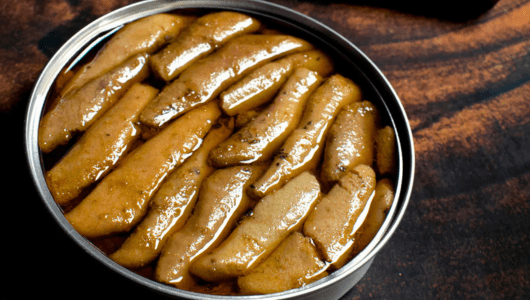
Photo by Lata Shop
Among Portuguese canned seafood, sardine roe is one of those products that makes you understand why the world of conservas deserves more attention than a quick souvenir purchase. Known in Portuguese as ovas de sardinha, they are sometimes nicknamed “Portuguese caviar”, which is partly marketing, but that doesn’t mean this isn’t one of the most delicate and unusual things you can find in a tin, certainly worth trying while in Lisbon.
Unlike standard canned sardines, sardine roe is not an everyday pantry item. It’s harder to produce, harvested during the summer season when female sardines are heavy with eggs, and more expensive, because each sardine yields only a small amount and the roe has to be handled carefully. They are traditionally packed in olive oil with little more than salt, while more contemporary versions may use spicy olive oil for extra intensity.
In terms of flavor, sardine roe is briny and deeply savory. It tastes unmistakably of sardine, but in a more refined way. Texture-wise, it’s granular and soft enough to spread on bread or a cracker and, just like you would do with caviar, you could put a little butter on the bread or a drizzle of olive oil on top so that the extra fat helps carry more flavor to your tastebuds. While you could technically cook with sardine roe, this is a product worth tasting on its own. If you have a comfortable budget and would like to taste Portuguese sardines in a rarer way, we would definitely recommend looking for ovas de sardinha at Lisbon addresses such as A Loja das Conservas (Tv. do Cotovelo 6).
Escabeche de sardinhas | sardines in vinegary marinade
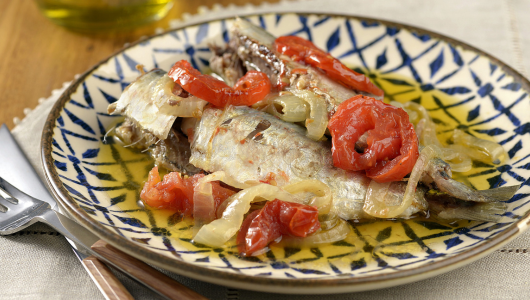
Photo by Portal Umami
Escabeche is a very old technique of preserving cooked fish in an acidic marinade, most typically made with vinegar, olive oil, garlic, bay leaf, and paprika. This method predates refrigeration by centuries and exists in various forms across the Mediterranean and beyond. Its roots are usually traced to Persian and Arab culinary traditions, arriving in the Iberian Peninsula during the Moorish occupation and spreading from there across European and eventually global cooking. The word itself is thought to derive from the Arabic al-sikbaj, a sweet and sour meat preparation that evolved differently depending on place. Here in Portugal, it was mostly applied to fish and, today, we still cook according to this method.
To prepare escabeche you can use regular sized sardines or small younger ones, locally known as petingas. The fish is cleaned, cooked, and then goes into the marinade, more often than not along with plenty of sliced onions. The fish is supposed to rest in the marinade for at least a day, but it can be more, and during this time the acid from the vinegar continues to work on the fish, firming the flesh slightly and deepening the flavors.
Escabeche is always eaten cold and, more than a meal, it’s enjoyed as a petisco or starter. It was common in traditional tascas and while it is not as prevalent today, you can still enjoy it, especially in simple restaurants or waterfront areas. In Lisbon, you could sample sardinhas em escabeche at places like Pap’Açôrda (Av. 24 de Julho 49), Senhor Peixe (Rua da Pimenta, Parque das Nações) or Páteo Restaurante (Av. Dom João II 11B).
It’s relevant to note that, after the 15th century, the escabeche tradition was taken from the Iberian peninsula to different corners of the world, thanks to Portuguese and Spanish sailors and traders. This cooking method reached Latin America, where it remains common across Peru, Mexico, and the Caribbean in various forms. It traveled to the Philippines, where today you can find paksiw, which is essentially fish cooked and preserved in vinegar. And it reached Japan, where the Portuguese presence in the 16th century introduced both tempura frying and the concept of marinating fried food in a sweet and sour liquid. The Japanese preparation nanban-zuke, which involves frying fish and then preserving it in a vinegar-based marinade with vegetables, is now widely recognized by food historians as a direct descendant of the escabeche the Portuguese brought with them. The name nanban itself, meaning “southern barbarian”, which was how the Japanese referred to the Portuguese at the time, helps identify the origin of the dish.
Sardinhas fritas | fried sardines
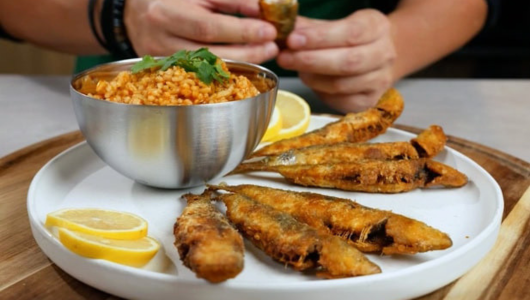
Photo by Pingo Doce
Even though many travelers seek grilled sardines when in Lisbon, fried sardines are just as popular among us locals, if not more. At home, because not everyone has an outdoor BBQ, we’re more likely to fry the fish than to actually grill it, so this is a dish a lot of us Portuguese eat on a regular basis.
To make fried sardines, just like you would do with many other species of fried fish, the sardines are cleaned, salted, coated lightly in flour or fine cornmeal, and fried until the skin is crisp and golden. They can be seasoned with a little lemon just before digging in. Most commonly they are served with standard accompaniments of boiled potatoes and steamed vegetables or, even better, loose saucy rice, funnily called naughty rice (arroz malandrinho) in our country, often flavored with things like tomato (arroz de tomate) or red kidney beans (arroz de feijão).
Petingas fritas are also quite loved and, being smaller, they save you the job of having to clean your fish with your fork and knife as you enjoy your meal. Fried whole until completely crisp, you can eat the entire piece, including flesh, skin and fine bones. They’re still a common petisco in older Lisbon tascas, and they pair well with a cold beer.
You are more likely to come across fried sardines or petingas in Lisbon while browsing the daily specials (pratos do dia) of simple day-to-day restaurants. To narrow your search, we recommend checking the rotating dishes at restaurants such as Flor da Estrela (Rua João de Deus 11) or Restaurante Alfaia (Tv. da Queimada, Bairro Alto). You are also likely to come across jaquinzinhos fritos or carapauzinhos fritos, which look very similar to sardines, but please note that these are small horse mackerel and, even though they are fried in exactly the same way, they are different fish.
Tiborna e torricado de sardinha | open sandwich with sardines
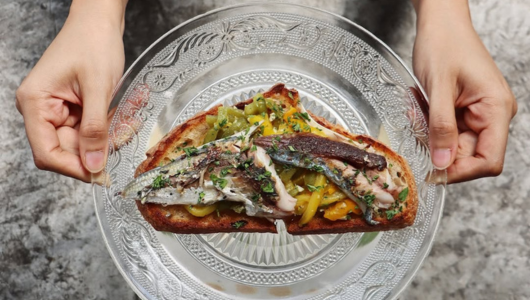
Photo by Bartolo Bakehouse
Tiborna and torricado are two preparations that can be enjoyed as either a snack or a meal and they are both amongst the best Portuguese recipes using old bread.
Torricado is strongly associated with Ribatejo, especially the areas around Santarém, Almeirim, Cartaxo and Azambuja. Traditionally, it was food for agricultural workers, particularly those working in the fields and vineyards along the Tagus plains. The idea was to take sturdy bread, often already a little dry, cut it open, toast it over the fire, rub it with garlic, season it with salt and drizzle it with plenty of olive oil. This cheap and filling meal was most commonly served with grilled salted cod, but sardines and other grilled foods were over time also used for this kind of preparation. A tiborna, on the other hand, can refer very simply to warm bread dressed with Portuguese olive oil, common in Alentejo cuisine.
Over time, both tibornas and torricados have seen their toppings vary from the most basic and rustic to more contemporary. Somewhere in between we find tiborna de sardinhas and torricado de sardinhas, usually topped with grilled sardines. These Portuguese-style open sandwiches can also be prepared with canned sardines and whatever else the cook might want to add as additional toppings, with common options including grilled peppers, tomatoes, onions and pickles. No matter the overall recipe, the bread absorbs the fat that drips from the fish, and it tastes delicious.
In Lisbon, this is not something you will find everywhere, but it does appear on menus that work with canned fish and petiscos. We like the torricado with sardines at Aldeia in Bairro Alto (Tv. da Queimada 32), for example. Tasca da Memória (Tv. da Memória 62) sometimes serves arjamolho with a sardine tiborna, which is a typical pairing from the Algarve that brings together cold tomato soup and sardines on bread. Can the Can (Praça do Comércio 82 83), one of Lisbon’s best-known restaurants dedicated to Portuguese conservas, also prepares tiborna de sardinha with green and red peppers.
Items on a menu come and go but, the good news is that this is also one of the easiest sardine ideas to recreate after your trip. If you brought home Portuguese canned sardines, simply toast a thick slice of good bread, rub it lightly with garlic while still warm, add a generous drizzle of olive oil, then place the sardines on top. This is a very simple and flavorful way to have a little taste of Portugal at home.
Arroz de sardinha | sardine rice
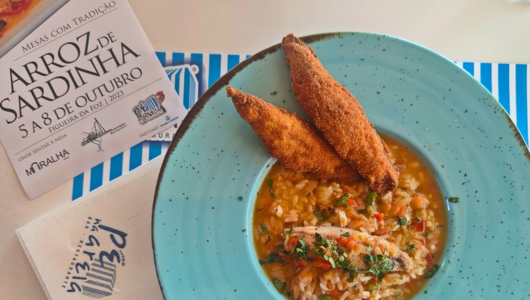
Photo by Meet Figueira
In Portugal, rice is often the main ingredient of a meal, especially in the loose and brothy style we call arroz malandrinho. The word malandrinho literally suggests something naughty, but at the table it means rice that has not been cooked dry. It should arrive with enough liquid to move on the plate, carrying the flavor of tomato, onion, olive oil, herbs and, in this case, sardines.
The traditional version is usually made with fresh sardines, particularly when they are in season. The base for arroz de sardinha often involves onion, tomato, pepper, bay leaf, rice of the short grain Carolino variety, olive oil, white wine and, in addition to the fish itself, a little kick of piri-piri sauce and a fresh finishing touch of parsley.
There are slightly different ways to handle the fish when preparing this rice dish. Some cooks add the cleaned sardines whole or in pieces toward the end of cooking, letting them steam gently over the rice. Others fillet the sardines first, which makes the dish easier to eat, especially for those who do not want to deal with bones at the table, even though, here in Portugal, we’re normally used to this from a young age. You could also do a more improvised version with canned sardines, such as those in olive oil or tomato sauce. This is such a home-style Portuguese food, that it is not specially easy to find in restaurants.
The dish has a particularly strong association with the coastal area around Figueira da Foz, where it is considered a reference of popular coastal cuisine. Two of its key ingredients, sardines and arroz Carolino from the Baixo Mondego, are locally produced. If you travel to Figueira da Foz, and specifically to the village of Buarcos, just north of the city, you’ll find it on restaurant menus more consistently than anywhere else in the country.
Caldeirada de sardinhas | sardine stew
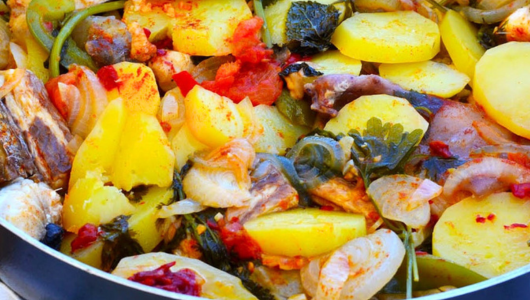
Photo by Ruralea
Caldeirada, a word related to caldeira, meaning cauldron, has its origins in the meals fishermen prepared after a day’s work, using the fish with the least commercial value. Whatever came up in the nets that couldn’t be sold, like small fish, damaged fish, or species that customers didn’t care for as much, went into the pot. In most caldeirada recipes, the fish is cooked together with sliced onions, garlic, ripe tomatoes, peppers, potatoes, olive oil, bay leaf, herbs and, sometimes, white wine. The idea is for everything to cook together slowly, without much stirring, until the fish and the aromatics release their flavor into the vegetables, particularly the potatoes.
Across Portugal, caldeirada changes according to place, season and budget. It can be made with a mix of fish, including firmer species such as monkfish, ray, conger, dogfish, grouper, skate, red gurnard or whatever is appropriate for stewing. Some versions include shellfish. Some are more tomato-heavy, others more brothy. In the Algarve and along parts of the coast, herbs such as coriander or pennyroyal may appear, while elsewhere parsley is more common.
Caldeirada de sardinhas is a humble and seasonal type of caldeirada. But because sardines are delicate, you can’t simply add them to the pot and forget about what’s cooking for an hour. To make sardine caldeirada, vegetables and potatoes need enough time to soften and create a sauce, but the sardines are usually added carefully and cooked just long enough to flavor the stew without falling apart completely. Some traditional-style recipes build the dish in layers from the beginning, placing potatoes, onion, tomato and sardines in the pot with olive oil and seasoning. Others cook the vegetables first and add the sardines later. In both cases, the best versions respect the fish’s texture. Caldeirada de sardinha works really well because of the fish’s fat content. A good summer sardine releases enough oil during cooking to enrich the broth in a way that leaner fish simply can’t match, and that richness is what makes caldeirada de sardinhas special, despite being prepared with modest ingredients.
Caldeirada de sardinhas is not as easy to find in Lisbon as grilled sardines in June or canned sardines in a shop. It may appear as a daily special in traditional restaurants, particularly when sardines are in season, but it is not usually a permanent menu item. If you take a day trip to coastal regions near Lisbon, particularly Setúbal, you might be able to find it at Peixe no Largo, a restaurant that serves caldeirada de sardinha at least during the city’s Sardine Week, although it is still worth confirming before you go.
Portuguese desserts that look like sardines but have no fish
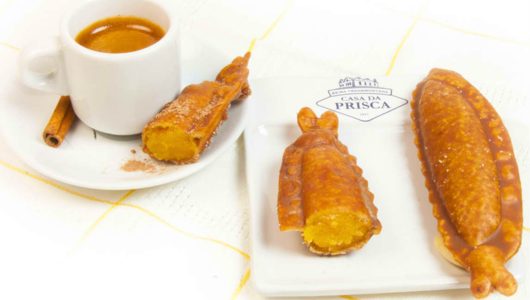
Photo by de.Gostar
By now, there is no doubt that Portugal takes sardines seriously. Besides the savory dishes we have explored above, we also make sweets that look like sardines but that, in most cases, do not contain any actual fish. In Lisbon, this is easy to spot, as specialty stores and souvenir shops will sell things like sardine-shaped chocolates and biscuits.
The more historically interesting sweet sardine, however, is found far from Lisbon, in Trancoso, in the district of Guarda. Sardinhas doces de Trancoso (pictured above) are a regional conventual sweet shaped like sardines, typically made with a crisp pastry shell filled with sugar, eggs and almonds rather than anything from the sea. These sweets are formed to resemble sardines and there is even a local confraternity, the Confraria das Sardinhas Doces de Trancoso, dedicated to protecting them.
Sardinhas doces de Trancoso are believed to have originated in the 17th century in the former convent of Santa Clara in Trancoso. One common explanation for the curious shape of this sweet says it emerged in an inland region where fresh fish was historically difficult to obtain regularly. While people waited for the real sardines to arrive from the coast, convent kitchens offered a sweet imitation instead. If you travel to this part of Portugal, we would recommend visiting Casa da Prisca, one of the best-known producers from the area, which still makes this regional specialty.
There have been more eccentric experiments too. Some Portuguese ice cream makers have occasionally played with sardines as an actual savory flavor, even though we believe this was done more as marketing and provocation. These short-lived experiments with sardine took some curious food lovers to places like Oliveira Gelados in Santa Maria da Feira but, at the moment, we do not have this ice cream flavor to help us beat the heat in a delicious way in Lisbon.
To keep exploring Portuguese food beyond the obvious, subscribe to the Taste of Lisboa newsletter and let us bring more local tips and Lisbon flavors straight to your inbox.
Feed your curiosity on Portuguese food culture:
A brief guide on how to order fish in Portugal
How to spot an authentic Portuguese restaurant in Lisbon (and avoid the tourist traps)
Comporta travel guide for food lovers
How to connect with local culture in Lisbon and Portugal
Real people, real food. Come with us to where the locals go.
Signup for our natively curated food & cultural experiences.
Follow us for more at Instagram, Twitter e Youtube