
The difference between Portuguese gaspacho and Spanish gazpacho
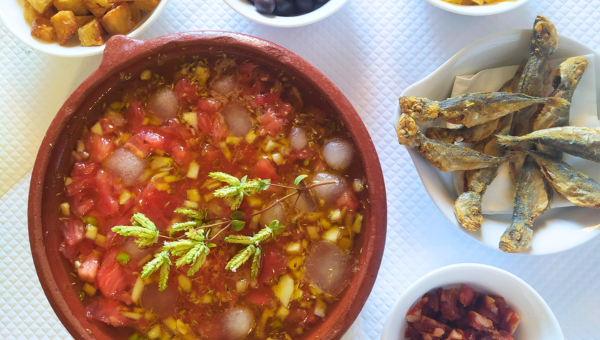
Most people hear gazpacho and think of Spain, picturing a cold, red tomato soup, usually blended smooth and served in a bowl, a glass, or, in more recent years, from a supermarket carton. That is perhaps the most famous version of gazpacho, strongly associated with the Andalusia region of Spain, but it’s certainly not the only one there is.
Feat. photo by NIT
Portugal is also relevant when we talk about Iberian cold summer soups. In Alentejo, we find gaspacho alentejano, which is a Portuguese-style cold tomato and bread soup, usually chunky rather than blended, prepared with diced tomato, cucumber, pepper, garlic, olive oil, vinegar, oregano, cold water and bread. In the Algarve, there is also another version of cold tomato and bread soup, arjamolho algarvio, which follows a similar recipe, with a consistency somewhere between a soup and a salsa, as it’s also not blended like it happens across the border in Spain.
In Portuguese, the dish is usually written as gaspacho, with an “s”, while the Spanish and more internationally familiar spelling is gazpacho, with a “z”. In Lisbon menus, however, you may still see both spellings, especially when restaurants are serving a Spanish-style blended version.
The shared background of these soups dates to a time before there were even tomatoes in the Iberian Peninsula. Tomatoes and peppers arrived in Europe from the Americas, after the Spanish and the Portuguese reached this continent in the 16th century. But, before that, we were already preparing recipes with old bread, garlic, olive oil, vinegar, salt and water. We could even look at things like migas or açorda like indirect predecessors of gazpacho because, even though they are not cold soups, they are resourceful Portuguese ways of cooking with old bread.
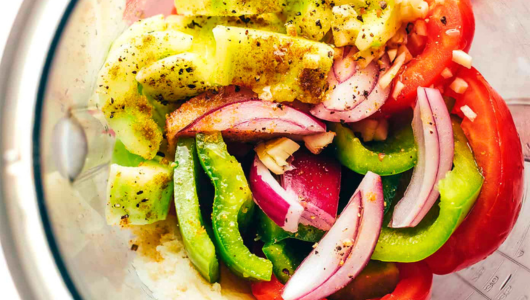
Photo by Gimme Some Oven
Portuguese and Spanish cuisines have a lot in common, but there’s also plenty of differences between them. So, while Spanish gazpacho and Portuguese gaspacho come from the same broad Iberian habit of stretching basic ingredients, making old bread useful again, making it work very well in hot weather, there are also interesting differences in what each country ended up doing with that common starting point.
The origins of Iberian cold soups
The history of gazpacho starts before tomatoes. The red cold soup most people recognize today only became possible after tomatoes and peppers arrived in Europe from the Americas but, before that, southern Iberia already had bread-based preparations made with ingredients such as garlic, olive oil, vinegar, salt and water, which are also essential to gazpacho.
There is not one single origin for gazpacho that food historians seem to agree on. While some theories connect it to Roman food habits, especially because of the use of bread, olive oil and vinegar, others point to Islamic influence in al-Andalus, the territory ruled by Muslims between the 8th and 15th centuries which covered most of the Iberian Peninsula, where bread, garlic, oil, water and salt were also part of everyday cooking. If repurposing old bread didn’t start with the Romans, it’s undeniable the Moorish influence we can still see in Portuguese cuisine today, so it is easy to establish a link there.
Because of the lack of tomatoes, the older versions of gazpacho would have been closer to a crushed or soaked bread mixture, seasoned with garlic, olive oil, vinegar and salt, then loosened with water. Made with cheap everyday ingredients mashed with a mortar, it was rustic and probably more common in rural households.
Tomatoes changed this family of dishes gradually but, although tomatoes reached Iberia in the 16th century after Portuguese and Spanish contact with the Americas, they did not become everyday food immediately. Like several ingredients from the so-called New World, they were first met with curiosity and, in some places, plenty of suspicion too. Because tomatoes belong to the nightshade family, many Europeans, particularly farther north, were slow to embrace them as food. In wealthier circles, they were also grown as ornamental plants before they became fully accepted in the kitchen. Later, by the 18th century, tomatoes started becoming more common in warmer European regions, where they grew well. In southern Iberia, they eventually started being used as part of older bread-based preparations, adding to them juice, acidity and a certain sweetness. So, gazpacho was not created from tomatoes as such, but tomatoes did end up transforming an older way of using bread, olive oil, water and seasonings.
By the 19th century, tomatoes had become central to the red Andalusian gazpacho that later became internationally famous. But that does not mean Portugal simply adopted a Spanish dish and left it unblended. It is more accurate to see Spanish gazpacho and Portuguese gaspacho as regional developments from a shared Iberian background. Andalusia produced the smooth red version that traveled widely while Portugal, especially the Alentejo and the Algarve, developed a chunkier version locals on this side of the border seemed to prefer.
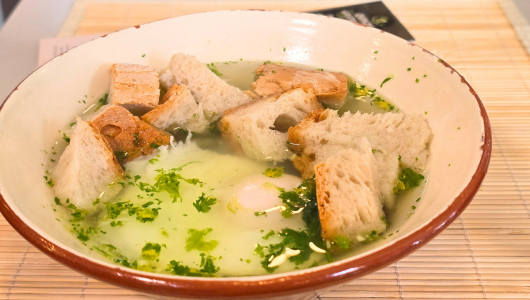
Photo by O Digital
Portugal’s place in this history is easier to understand through its bread culture, particularly in Alentejo. Alentejo-style bread (pão alentejano), garlic and coriander soup (açorda alentejana – pictured above) is not a cold nor a tomato soup, but it shows the same approach, making good use of bread softened with liquid, seasoned strongly, and turned into a meal. The word açorda is linked to the Arabic thurda, meaning soaked bread, which points to the long Arab influence in southern Iberian cooking. Portuguese bread dishes such as migas follow a similar principle, using yesterday’s bread with fat, seasoning and whatever else was available, such as herbs or vegetables.
These dishes are not ancestors of Portuguese gaspacho in a direct, recipe-by-recipe sense. But they do show why gaspacho alentejano naturally came about in Alentejo, where bread is still such an important element of the local food culture.
The difference between gazpacho and gaspacho is therefore not only about blending. It is also about the role of bread. In the Spanish version most people know, bread helps give body to a smooth cold soup. In Portuguese gaspacho alentejano, bread stays more visible and substantial, alongside diced vegetables. Both belong to the same Iberian family, but Portugal’s version keeps closer contact with the older preparations with bread that came before tomato.
Spanish gazpacho as the famous reference point
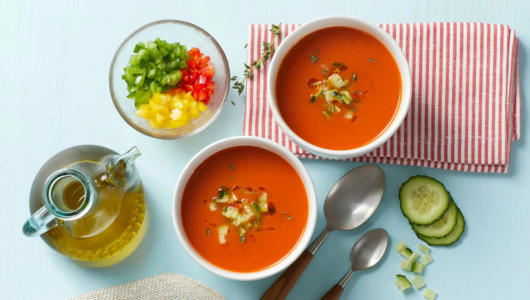
Photo by HOLA
The Spanish version most travelers know is Andalusian-style cold tomato soup, gazpacho andaluz. It is usually made with ripe tomato, cucumber, pepper, garlic, olive oil, vinegar, water and salt. Bread may also be added to give the soup more body, but the final result is generally light and fairly liquid.
This is the gazpacho that became famous outside Spain, particularly in modern times when making it using an electric blender is way easier than back in the day, when everything was done manually with a mortar. In gazpacho, tomato and watery vegetables such as cucumber and pepper keep the soup fresh and fluid, while olive oil gives body, vinegar adds acidity, and bread, when used, helps bind the mixture without necessarily turning it into a thick cream.
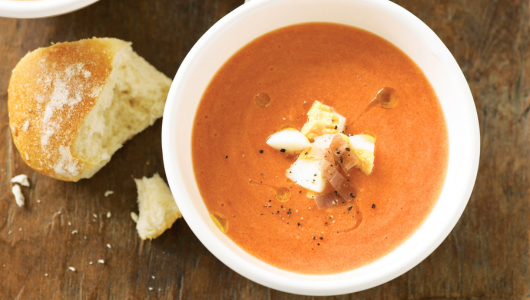
Photo by Taste
Salmorejo, also known as salmorejo cordobés, is another cold tomato and bread soup from the Spanish city of Córdoba, but it is thicker and more filling than gazpacho, as it usually contains considerably more bread. The result is closer to a cold purée than to a drinkable soup, and it is often served with chopped boiled egg and strips of cured ham on top.
Spain also has older tomato-free cold soups such as white garlic and almond soup (ajoblanco), which also include bread, olive oil and vinegar but without the red tomato base.
In Portuguese gaspacho alentejano, bread is also a key ingredient, and in this case it stays visible rather than disappearing completely into the blend.
What is Portuguese gaspacho?
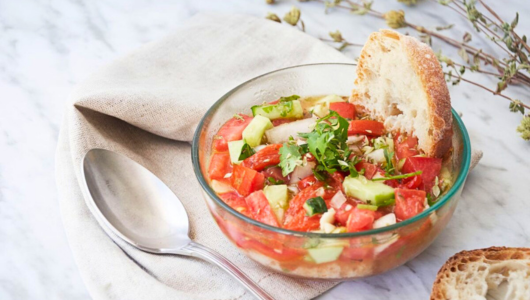
Photo by Ruralea
Portuguese-style cold tomato and bread soup (gaspacho alentejano) is strongly associated with Alentejo, where it is usually made with diced tomato, cucumber, green pepper, garlic, olive oil, vinegar, cold water, oregano, salt and stale bread. This cold soup appears mostly during the summer when in hot areas such as the region of Alentejo, a refreshing meal that does not require using the stove is much welcome. This is also tomato harvest season and, alongside the other vegetables used, this is when they are juicier and tastier, thus resulting in a more flavorful soup. It also happens to be one of those traditional Portuguese dishes that is naturally plant-based.
Besides using oregano as an aromatic, the basic ingredients are close to Spanish gazpacho, but the method leads somewhere else. In gaspacho alentejano, the garlic is often crushed with salt, olive oil and vinegar to create the seasoning base. The vegetables are cut into small pieces and added to cold water. The bread is added in chunks, mixed in shortly before eating so that it softens and absorbs the flavors, but not with too much time in advance that it becomes way too soggy. This is a cold soup but not a purée, so chewing is required while eating it, as it would be if you were eating these chopped ingredients as a salad, without the refreshing water that bathes them thus transforming the liquid into a sort of cold broth.
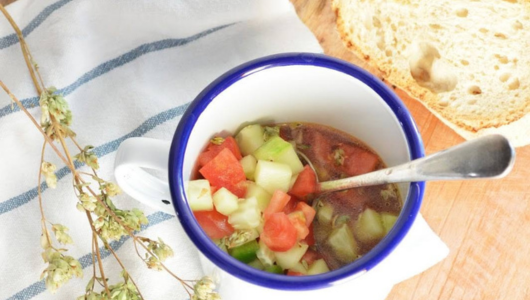
Photo by Paixão Alentejana on Facebook
This is not a case of Portugal keeping an “older” version of the recipe because it missed the blender. Spanish gazpacho was also made before electricity, traditionally using a mortar and pestle to crush the garlic, bread, oil, vinegar and vegetables into a more unified mixture. Of course the modern blender ended up making that texture easier and more consistent, but it did not invent the idea of a smoother gazpacho per se, as the Spanish tradition already had a tendency toward crushing and emulsifying the ingredients, even if done by hand.
Portuguese gaspacho alentejano simply went in another direction and its character depends precisely on this contrast between the cold broth, the sharpness of the vinegar, the chunky ingredients and the consistency of the bread that is soft but does not end up disappearing in the liquid. Gaspacho alentejano is rustic, refreshing and aromatic, and it’s a delicious way to beat the summer heat in Portugal.
What is arjamolho algarvio, and how is it different from gaspacho alentejano?
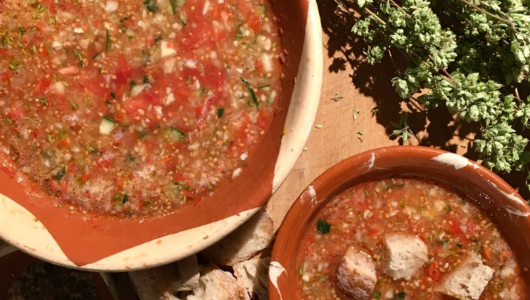
Photo by O Cozinheiro Este Algarve
At first glance, arjamolho algarvio can look almost identical to gaspacho alentejano. The ingredients are essentially the same, that is, tomato, cucumber, green pepper, garlic, olive oil, vinegar, cold water, salt, stale bread and, often, oregano. The difference is in the way the dish is built and how it is consumed.
In gaspacho alentejano, the dish is usually structured as a rustic cold soup. The vegetables are diced, the water is seasoned with garlic, olive oil, vinegar, salt and oregano, and the bread is added in pieces so it softens in the broth but without disintegrating.
The recipe for arjamolho, sometimes also referred to as gaspacho algarvio, often begins by crushing garlic, salt, tomato and sometimes bread into a base, usually with olive oil and vinegar. Cold water is then added, followed by chopped tomato, pepper, cucumber and more bread. This gives arjamolho a slightly different structure, part crushed base, part chopped vegetables, part soaked bread. Depending on who prepares it, it may feel like a cold soup or more like a wet bread salad.
In the Algarve, arjamolho is strongly associated with summer meals by the coast and is often served with grilled sardines or fried fish. It’s a good complement to fish because of its freshness and acidity, also helping make a meal of fish more substantial.
There was even an attempt to make arjamolho famous on a global scale. In 2006, the Confraria dos Gastrónomos do Algarve prepared a 6,000-liter arjamolho in Portimão, serving around 4,500 people and entering the Guinness World Records for the world’s largest soup. The record has since been beaten several times, and the current Guinness title belongs to a 30,292-liter tarhana soup prepared in Uşak, Turkey, in 2024. Still, the Portimão event still works as an example of local pride around a dish many visitors to Portugal, and even Portuguese people from other parts of the country, have never heard of.
In other words, arjamolho algarvio is not radically different from gaspacho alentejano in ingredients, but it has small differences that give it its own regional identity. In Portugal, gaspacho alentejano is generally better known, while arjamolho is less familiar outside the southern region of the Algarve. At the same time, all of these identities and categories are not rigid and, today, many Portuguese home cooks might prepare Alentejo-style gaspacho when they feel like something chunky to be eaten with a spoon, but also blended Spanish-style gazpacho (known in Portugal as gaspacho à Espanhola), when they want something more liquid to drink directly from a glass, but that could also indeed be eaten with a spoon.
How gazpacho and gaspacho are eaten today
The blended Andalusian version of gazpacho became the international reference, helped by restaurants, cookbooks, packaged supermarket versions that usually come in tetrapacks and the simple fact that it is easy to serve, smooth and ready to drink. That visibility also influenced the way many people outside Spain, including in Portugal, understand the word “gazpacho”.
In Portugal, gaspacho alentejano and arjamolho algarvio are still more regional than universal, and despite their growing popularity in recent years, they are still not dishes you should expect to find on every Portuguese restaurant menu around Lisbon. In many cases, they will show up as part of the daily specials or soups of the day (pratos do dia or sopas do dia), more than on the permanent menu.
Restaurants have also stretched the idea of gazpacho far beyond the classic tomato version. In contemporary menus, gazpacho often means any cold, savory summer soup built around ripe produce, acidity and olive oil. You may see watermelon gazpacho, strawberry gazpacho, cucumber gazpacho, beetroot gazpacho, cherry gazpacho or a combination of any of these fruits and vegetables with the more traditional tomato base.
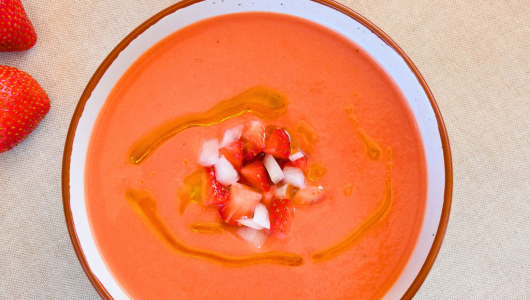
Photo by Newlux Recipes
Even the modern versions follow the basics of the original recipe, that is, mixing acidity and salt with good balance. For instance, a watermelon gazpacho can work beautifully if it has enough vinegar, tomato, olive oil or herbs to keep it savory. A strawberry version needs some restraint as not to make the soup overly sweet, but it tastes delicious if it has enough sharpness from the other ingredients.
For travelers in Portugal, this means there are three different experiences to look for. One is traditional gaspacho alentejano, chunky and bread-based. Another is arjamolho algarvio, more regional and usually harder to find outside the Algarve. The third is the contemporary gazpacho-style cold soup, which may appear in Lisbon restaurants during summer with tomato, but also other fruits or vegetables.
Where to eat Portuguese gaspacho in Lisbon
Finding gaspacho alentejano in Lisbon is possible, but it is not as straightforward as ordering other typical Portuguese soups such as caldo verde. Keep in mind that this is a seasonal dish, so most restaurants which do serve it will do so only during the warmer months.
For traditional Portuguese gaspacho alentejano, we recommend some of the best Alentejo restaurants in Lisbon, such as:
O Galito
Rua Adelaide Cabete 7, 1500-441 Lisbon
www.instagram.com/restaurante_o_galito
Casa do Alentejo
Rua das Portas de Santo Antão 58, 1150-268 Lisbon
https://casadoalentejo.pt
Talego
Rua Prof. Sousa da Câmara 147, 1070-103 Lisbon
www.instagram.com/restaurante.talego
Other Portuguese restaurants and establishments dedicated to drinks and petiscos in Lisbon, which also prepare gaspacho, include:
Bica Sour
Rua da Bica de Duarte Belo 31, 1200-057 Lisbon
https://bicasour.pt
Garrafeira Estado d’Alma
Rua Alexandre Herculano 58A, 1250-012 Lisbon
https://garrafeiraestadodalma.pt
Lisboa Tu e Eu
Rua da Adiça 58, 1100-116 Lisbon
www.instagram.com/lisboatueeualfama
Finding arjamolho algarvio in Lisbon is trickier because this regional recipe does not appear often on standard Portuguese menus. We recommend checking before going there on purpose, but these are some of the restaurants in Lisbon which are known to occasionally serve arjamolho algarvio:
Taberna Albricoque
where arjamolho is served with grilled sardines
Rua dos Caminhos de Ferro 98, 1100-395 Lisbon
www.instagram.com/taberna.albricoque
Tasca da Memória
served with marinated sardine tiborna
Tv. da Memória 62, 1300-403 Lisbon
https://tascadamemoria.pt
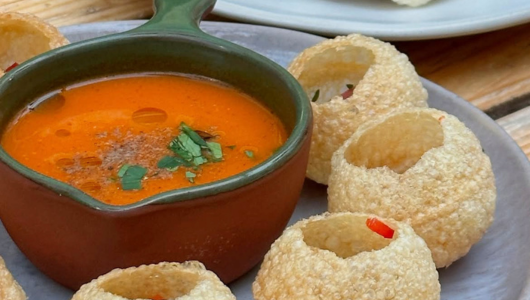
Photo by O Gambuzino on Instagram
If you have already given classic gaspacho and arjamolho a try, you may want to explore more contemporary versions, such as:
Fermented tomato and watermelon gazpacho served inside pani puri shells at
O Gambuzino
Rua dos Anjos 5A, 1150-032 Lisbon
Watermelon gazpacho with burrata and fresh figs at
Cenário
Avenida 5 de Outubro 197, 1050-054 Lisbon
www.instagram.com/cenario.restaurante
Watermelon gazpacho from
Organi Chiado
Calçada Nova de São Francisco 2, 1200-300 Lisbon
Strawberry gazpacho at
Corrupio
Rua da Moeda 1 F/G, 1200-275 Lisbon
www.corrupio.pt
Watermelon and pennyroyal gazpacho at
Palácio Chiado
Rua do Alecrim 70, 1200-018 Lisbon
www.palaciochiado.pt
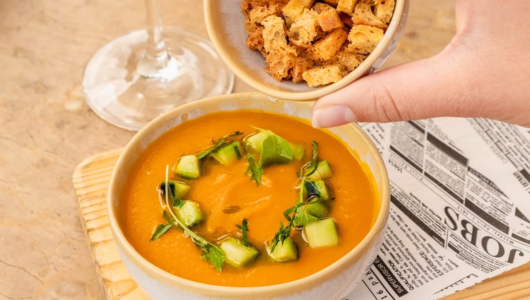
Photo by Lumi Rooftop on Instagram
Carrot and ají amarillo gazpacho at
Lumi Rooftop
Rua de São Pedro de Alcântara 35, 1250-237 Lisbon
www.thelumiares.com/eat-and-drink/lumi-rooftop
Beetroot gazpacho at
O Frasco
Rua das Amoreiras 85, 1250-022 Lisbon (inside Amoreiras Shopping Centre)
Roasted peppers gazpacho with marinated tomatoes toast at Luso-Moroccan restaurant
Arady
Av. Conselheiro Fernando de Sousa 5, Loja B, 1070-217 Lisbon
Spanish gazpacho may be the name most travelers recognize first, but Portuguese gaspacho alentejano and arjamolho algarvio are worth looking for if you are a food-curious traveler exploring Portugal.
To dive deeper into Portuguese food culture join one of Taste of Lisboa’s food and cultural walks in Lisbon and subscribe to our newsletter for more food recommendations and Portuguese food history.
Feed your curiosity on Portuguese food culture:
The best Portuguese cold dishes to eat in summer
Bairro Alto vs Cais do Sodré: where to eat authentic food in two most lively Lisbon neighborhoods
How to choose the right food tour in Lisbon for your travel style
Real people, real food. Come with us to where the locals go.
Signup for our natively curated food & cultural experiences.
Follow us for more at Instagram, Twitter e Youtube