Why octopus, not cod, rules the Christmas table in Northern Portugal
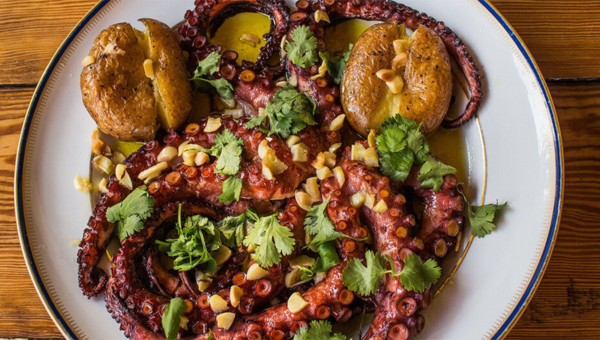
For most Portuguese people, Christmas Eve’s main dish revolves around bacalhau, the beloved salted version of cod our country is obsessed with. It’s usually a very simple recipe, featuring boiled cod with potatoes and greens. But, curiously, in northern Portugal, particularly in the regions of Minho, Douro interior, and Trás-os-Montes, the smell that fills the kitchen on the 24th of December is not cod, but octopus (polvo).
Feat photo by Rádio Vale do Minho
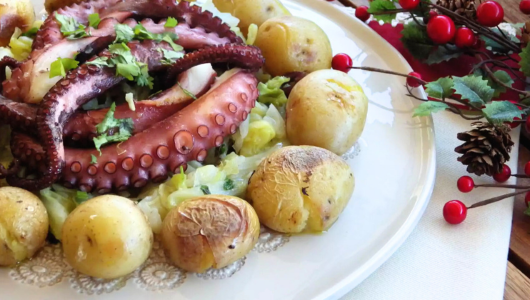
Photo by SAPO
Curiously, the octopus is the star of northern tradition, but particularly in areas more inland, and also in territories historically isolated because of their mountainous topography. It seems paradoxical that octopus, an ingredient you’d usually purchase fresh, versus preserved dry cod, would be so popular in areas far from the coast. But octopus at Christmas is part of the northern Portuguese identity, which has defied the liturgical rules of Catholic Portugal and, during the dictatorship, even political pressure, as bacalhau was imposed as a sort of patriotic fish of the Portuguese table. Up north today, Christmas Eve dinner (consoada) probably includes both octopus and cod.

Photo by SmartFarmer
How geography and old trade routes made the octopus a northern Christmas staple
To understand why octopus became the Christmas dish of Portugal’s northern interior, it helps to look beyond the map. These regions may sit far from the coast, with small villages between river valleys and with cold winters, but they were never as cut off as the geography suggests. Minho and Trás-os-Montes maintained constant movement of people and goods, especially across the border with Galicia, in Spain. Long before modern transport and official trade routes, these areas relied on informal networks, seasonal markets and family connections that kept them linked to the Atlantic world, and to products like octopus.
Northern Portugal and Galicia share a border, and they also share family names, expressions of local dialects, agricultural patterns, and a long tradition of trade across the border that has literally been going on for centuries. People married across the border, worked across the border, and, of course, traded across the border too. Fish moved between the two regions the same way olive oil, livestock, flour and tobacco did, that is, officially when it suited the authorities, and mostly unofficially when it didn’t.

Photo by Melgaço, entre o Minho e a Serra
Octopus thrived in this shadow economy. Galician boats fished it in abundance, and much of it travelled south through itinerant vendors and small-time contraband that “everyone” knew about but pretended not to see. Octopus would arrive from Galicia into northern Portugal wrapped in cloth bundles, sold discreetly at fairs, or brought home by relatives working near the coast. Cod, in contrast, was tied to a completely different distribution system that had to do with national fleets, commercial networks run by the state, and, later on, even political propaganda. Octopus, on the contrary, came from closer and from the people you knew.
Before modern refrigeration, octopus was relatively easy to handle compared to other fish. It could be dried, lightly smoked, or even transported alive in barrels of seawater on short trips inland. Once northern families got used to having octopus on Christmas Eve, the habit stuck. Geography helped establish the practice, and local culture ensured it continued from one generation to the next.
The dictatorship, cod propaganda and the persistence of northern octopus
If geography and religion explain why northern families embraced octopus, politics helps explain why the rest of the country leaned so heavily towards salted cod. In the 20th century, bacalhau became a national project. Under the Estado Novo regime, Salazar’s government invested heavily in promoting cod as the patriotic fish of Portugal. It was reliable (thus gaining the nickname it is known as until today, o fiel amigo), it stored well, and, importantly, it fit the regime’s narrative of self-sufficiency and discipline. Cod fleets were celebrated, consumption was encouraged, and propaganda painted bacalhau as a unifying element of the Portuguese table.
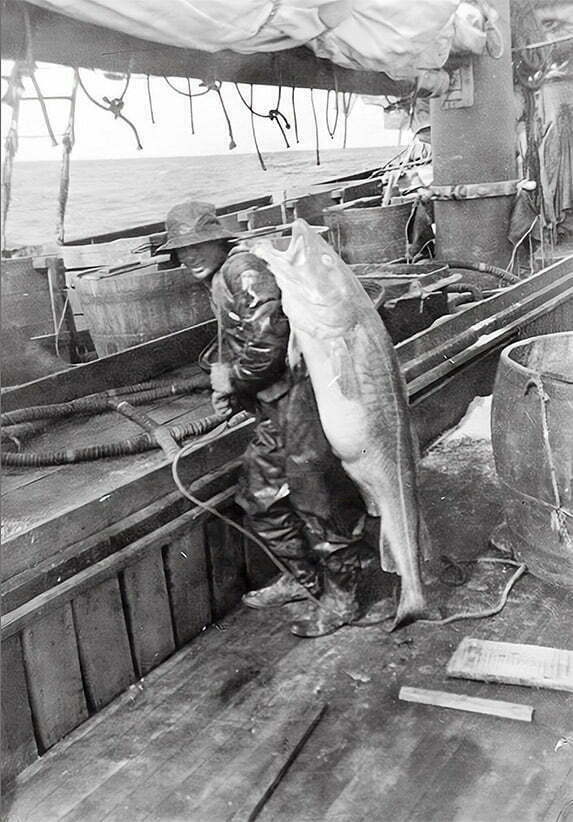
Photo by Mar Sem Fim
This political effort had very little to do with regional preferences, as it was simply about ideology, control and logistics. While cod could indeed be standardised, octopus could not. Cod depended on national fleets and imports regulated by the state, while octopus arrived through a mix of local fishing, cross-border trade and small scale distribution. One fit the model of a centralised economy, but the other certainly didn’t.
In the North, however, the cod campaign didn’t fully stick. Northern families did eat salted cod at other times of the year but, during the special meal on Christmas Eve, nothing was to replace the symbolism of octopus and its connection with the local identity, something not even the pressures of the Estado Novo managed to change.
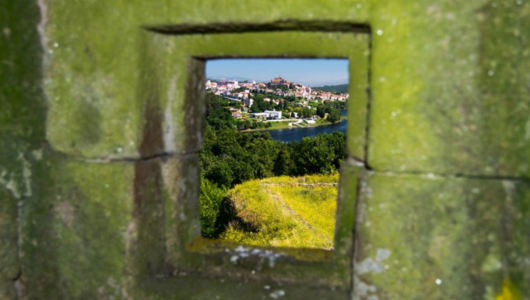
Photo by E-konomista
There’s also the practical detail that historians and food writers keep returning to, and that is contraband. Throughout the 20th century, Galician octopus continued crossing the border through unofficial channels, especially around Christmas. The regime even tried to restrict this trade to encourage more cod consumption, but it had little effect. Sometimes, the PIDE, the state’s secret police, did seize loads of octopus and, on some of those times, they would simply burn hundreds of kilos of the catch at the border itself, which was incredibly wasteful. But, despite all of this, northern households kept buying octopus however they could, and the dish stayed firmly in place. In the end, what ended up on the Christmas table materialized into a certain form of resistance, more cultural than political.
How northern Portuguese families cook Christmas octopus
If you were to spend consoada in the Minho, Douro or Trás-os-Montes, you’d realize that there are a variety of octopus recipes that land on the northern Christmas table.
The most traditional version is polvo cozido, a straightforward preparation where the octopus simmers slowly in a large pot until tender. The tentacles are cooked whole, often with a whole onion or a splash of vinegar to help with texture. Once ready, it is sliced thickly and served alongside potatoes and couve penca, the sturdy northern cabbage. Everything is finished in Portuguese style with a generous pour of olive oil, raw garlic and, sometimes, even a little paprika (like they do in Galicia with polbo á feira).
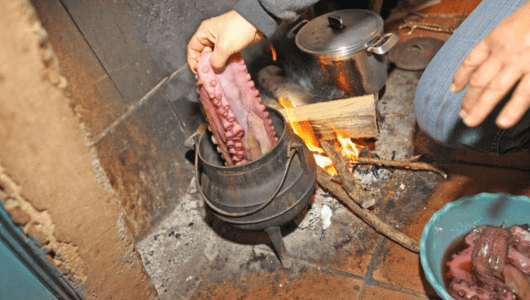
Photo by Receitas da Mamã
In some homes, particularly closer to the Douro, octopus appears as polvo assado no forno or polvo à lagareiro. In this case, the octopus is roasted in the oven with olive oil, onions, garlic and sometimes a small amount of wine, developing a slightly caramelized flavor. The potatoes are roasted alongside it, absorbing the juices as they cook. This version is less common for the consoada itself but often shows up the next day, when the family gathers again for the 25th.
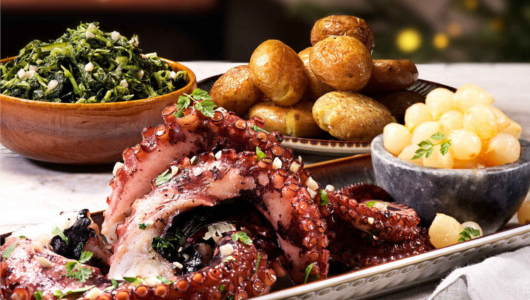
Photo by Continente
Older generations still talk about how they used to tenderize the octopus. Before the possibility of freezing it made things easier, as it softens the flesh naturally, the octopus was sometimes beaten against a stone basin to break down its fibers.

Photo by Guía Repsol
Another important detail is that, in many households, octopus and cod are served together, as complementary parts of the Christmas table. Bacalhau provides familiarity and a link to the rest of the country, while polvo helps highlight the regional identity of the family.
Food historians often say that Christmas dishes are among the last to change, because they are tied to memory more than to practicality or routine. The only significant change in recent years has probably to do with the economy, as octopus has become more expensive, especially around Christmas. Yet even with rising prices, northern families tend to hold onto the tradition, even if that means adjusting the quantities rather than omitting octopus from the menu altogether. Cod may dominate the national image of Christmas Eve, but octopus still rules the northern table because it speaks directly to the people who sit at it.
To read more stories that explore how Portugal’s culinary culture is richer and more diverse than many would imagine, follow Taste of Lisboa on Instagram and subscribe to our newsletter to receive our latest articles straight to your inbox.
Feed your curiosity on Portuguese food culture:
The best Portuguese octopus dishes (and where to try them in Lisbon)
Best seafood restaurants in and around Lisbon
A brief guide on how to order fish in Portugal
The history of Fado and how to experience it live in Lisbon
Real people, real food. Come with us to where the locals go.
Signup for our natively curated food & cultural experiences.
Follow us for more at Instagram, Twitter e Youtube