
The women behind Lisbon’s food
When people talk about women in Portuguese gastronomy, the focus often goes to visibility in professional kitchens, more often than not, high-end ones.
In 2025, for example, chef Marlene Vieira earned a Michelin star, a milestone the media portrayed as quite historic for women in Portugal’s fine dining scene, as a woman had finally entered the club long dominated by men. This was an important moment, we wouldn’t question that, but it’s relevant to mention that it wasn’t unprecedented. Decades earlier, chef Maria Alice Marto, known to the country simply as Tia Alice, had already received a Michelin star for her restaurant in Fátima. She kept her star for three consecutive years, at a time when Portugal had only a handful of starred places in total. After Tia Alice lost her Michelin star in 1996, no other Portuguese woman received that distinction for roughly thirty years.
Feat. photo by Barlavento
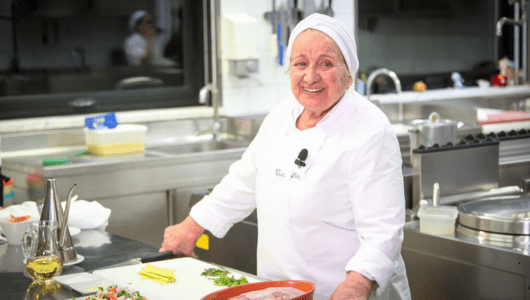
Photo by Restaurante Tia Alice
But this is not another list of acclaimed female chefs, as in fact, we have already written that article and those stories certainly matter. We feel this one is about something bigger.
If you look at how Lisbon actually eats, the foundations of our food culture were not built in fine dining kitchens. They were built in domestic spaces, markets, convents, small neighborhood tascas, and even school cafeterias where many of us ate while growing up. And in most of those spaces, historically, the cooks were women.
There’s an irony that’s hard to ignore: ask many of Portugal’s most celebrated male chefs how they started to cook, and the answer is often with their mother or grandmother. Rarely, if ever, is the father mentioned, and we all know that, in our country, as in most parts of the world, cooking knowledge was transmitted through women for generations. Yet when culinary work became professionalized and eventually even publicly prestigious, the highest-ranking titles ended up in male hands. At home, cooking was considered a duty, while in restaurants, it became a vocation. In one sphere, it was simply expected, while in the other, it was celebrated.
Regardless of how much attention famous male chefs get, the truth is that women continued to shape the Portuguese palate, but it was in ways that rarely translated into status. Even without formal training, they were the ones responsible for feeding the family, and even stretching ingredients during the austerity years of the Estado Novo dictatorship, for example. There’s no doubt that women, in particular nuns, were responsible for developing Portugal’s most famous range of desserts, conventual sweets. They also preserved seasonal foods and perishable goods before refrigeration was widespread, for instance making batches of quince cheese (marmelada) many of us enjoyed while growing up. They woke before dawn to prepare meals for hundreds of schoolchildren. They cleaned, salted, and processed fish in industrial facilities. They wrote recipes in notebooks without measurements, relying on repetition and instinct, but still solidifying the repertoire of classic Portuguese dishes.
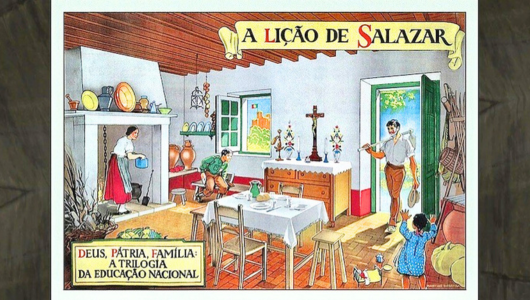
Photo by RTP Ensina
And as Lisbon grew and diversified, especially after the late 1970s when the dictatorship ended, the women who fed our city became even more varied. Rural domestic workers brought recipes from Minho, Trás-os-Montes, Alentejo and the Beiras into urban households, while women from Portugal’s former colonies introduced their own culinary traditions into Greater Lisbon’s private kitchens and eventually public businesses too.
This article is not about denying the importance of the women who now occupy visible positions in Lisbon’s dining scene. It’s about exploring spaces and jobs often considered ordinary but that still show how female figures, who are very rarely celebrated, have so much to do with how Lisbon eats today.
Portuguese women and everyday cooking at home
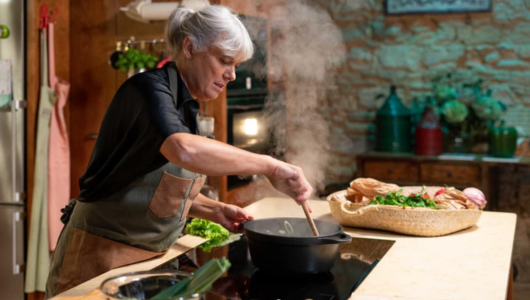
Photo by Mesaluisa on Facebook
Most of what we normally refer to as Portuguese food was not born in restaurants, but at home, often by the hands of women.
Anthropologists often distinguish between work that is recognized as “productive” and work that is seen as “reproductive”. One is counted in the economy, while the other basically keeps everyone alive. Cooking at home, often by women, falls into the second category.
Under the Estado Novo dictatorship, for instance, the ideal wife and mother was supposed to run an efficient yet modest household, where nothing was wasted, serving regular proper meals to the family. This had nothing to do with talent, as it was mostly about duty. But it was linked with some aspects that are now romanticised as part of traditional Portuguese cooking, such as starting meals with a simple soup, the taste of long-cooked stews that stretched basic ingredients, and even the familiarity of bacalhau in countless variations. Because home cooking was unpaid yet constant, it was rarely seen as expertise. Yet the decisions made in home kitchens shaped our entire country’s palate.
Women at home learned to cook with the older women in their family, and perfected recipes thanks to observation and repetition. That’s why many of our moms would still teach us a recipe and say things like “cook until it’s done” or “mix until you achieve the desired texture”, as if you’re supposed to know these things by default.
The emotional weight of this work is also often glossed over. Feeding a family is about cooking, but also about logistics and even expectation management. In many Lisbon households, until not that long ago, it was taken for granted that the woman of the house would know how to cook “proper Portuguese food”, even if she also worked outside the home. Until today, if you are a part of a more conservative family, this involves the pressure of organizing the shopping list, doing the actual shopping, ingredient preparation and eventually cooking something that won’t eat up your entire time during the week, but that on a given Sunday feels elaborate enough for a family lunch.
Historically, preservation was another part of this invisible expertise. Before freezers became common, women were the ones who figured out how to make the most of seasonal ingredients. They boiled kilos of quince into marmelada to last through winter, made jams with various fruits, dried figs, cured olives in brine and salt, and so much more. A lot of what there is in the Portuguese pantry today has to do with that work typically done by women.
The foundational knowledge of Portuguese cooking has for a long time been transmitted through women in domestic settings so, when we talk about “the women behind Lisbon’s food”, we ought to think about the repetitive often inglorious work done at home for many generations, before women started being celebrated as an integral part of Portugal’s culinary identity.
Domestic workers and migrant cooks
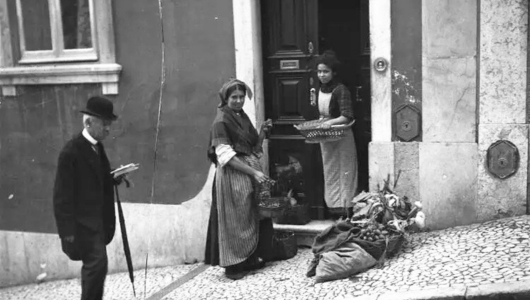
Photo by Esquerda
If most Lisbon homes were, and still are, fed by the unpaid work of wives and mothers, there has always been another layer of everyday cooking in the city, reserved for wealthier families, and that is the people who are paid to keep someone else’s household running.
In Lisbon, having a criada or empregada interna was historically a privilege of the middle and upper classes. During the Estado Novo years, it was common for families in more affluent neighbourhoods to have a young woman living in, often coming from the countryside, who would take care of cleaning, laundry and, in many cases, cooking. She was probably from Minho, Trás-os-Montes, the Beiras or Alentejo, historically humbler areas of Portugal, and was sent to the capital to help a family and, in return, receive a wage, room and board, and sometimes the promise of education or a better life, which did not always materialise. For the employers, this extra pair of hands made it easier to sustain the ideal of the well-run household.
Not every domestic worker cooked. In some houses, the live-in maid took care of everything, from breakfast to Sunday lunch, while in others, she focused on cleaning, while the lady of the house kept control of the kitchen, especially for more formal meals. Even today in Lisbon, you’ll find all kinds of arrangements from hourly cleaning ladies who never touch a pot, part-time workers who prepare food but don’t stay to serve, and long-term employees who are effectively the main cook of the household. Domestic work is a broad category, and cooking is just one part of it, but an important one.
As Lisbon changed after the Carnation Revolution in 1974, domestic and social dynamics changed a great deal. More women from the host families themselves entered the labor market full-time, which increased the demand for paid domestic services at home, especially in urban centres like the capital. At the same time, internal migration from rural Portugal continued, and post-colonial migration started to reshape the city. From the mid-1970s onwards, significant numbers of women from Cape Verde, Angola, Guinea-Bissau, São Tomé and Príncipe and Mozambique arrived in the Lisbon metropolitan area, many of them finding work in cleaning and domestic service. From the 1990s on, Brazilian women became very visible in these sectors too, along with migrants from Eastern Europe.
Today, paid domestic work in Portugal is still overwhelmingly done by women. When these workers are responsible for cooking, the kitchen becomes an interesting space of negotiation. Sometimes the expectation is that they reproduce “proper Portuguese food” the way the employer’s mother or grandmother used to do it, so the domestic worker is hired to perform a version of culinary tradition that isn’t part of her background or skills, but that she is expected to learn and execute. In other homes, especially where the relationship is closer or has lasted for years opens room for exchange, and the worker’s family recipes are introduced and gradually become the employer’s family dishes as well. The same has even happened with migrant women from outside mainland Portugal, who have, for instance, been responsible for introducing some African and Brazilian recipes into Portuguese households in Lisbon, before these became popular in restaurants. This is not the most visible face of Lisbon’s gastronomy, but it is a deep-rooted part of the daily reality of how the city eats.
Women in agriculture and Lisbon’s market stalls
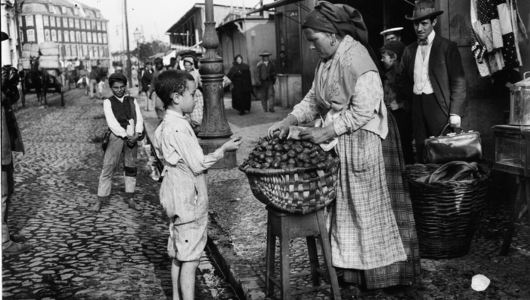
Photo by CM Lisboa on X
Historically, food consumed in the Portuguese capital came from the north and northwest of Lisbon, the so-called zona saloia. This kind of green necklace around the capital was full of fields, orchards and pastures that supplied – and still do – Lisbon city with fresh vegetables, fruit, dairy and meat. Less than a century ago, areas that today we perceive as urban Lisbon, like Alta de Lisboa, were still farmland, growing and sending food into town every day. Mafra, which you may recognize from our guide for food lovers, was and still is one of the emblematic centres of this region, historically described as “Lisbon’s breadbasket”.
The word saloio itself originally referred to rural people around Lisbon. Saloios mostly lived on small family farms, where men used to handle ploughing or livestock, while women were involved in almost everything else. We’re talking about sowing, weeding, harvesting, milking, making fresh cheese, tending small animals, and keeping the vegetable gardens that were crucial for daily food. Even recent data on Portuguese agriculture confirms what local memory already knew, and that is that around 68% of the country’s agricultural workforce is in family farming, and almost half of those workers are women. Official EU figures also note that women are now managers of close to 39% of Portuguese farms overall.
Until not that long ago, farming production was only half the story, as the other half was getting those fresh products into Lisbon and selling them. For generations, women embraced its trade and loaded vegetables, eggs, chickens, and cheeses onto donkeys, carts and later trucks, and travelled towards the capital. Some sold directly in neighbourhood squares or at informal stalls, while others took their place behind bancas in municipal markets. Historically, many of these vendors were exactly the women who had been working in the fields with the family the day before, or their daughters. The saloias who came into town with baskets of produce and fresh cheese were both farmers and traders, moving between the rural and the urban world. If you walk through Lisbon’s older markets even today, like those in Campo de Ourique, Alvalade, Benfica or Arroios, you’ll notice that a large number of the fruit and vegetable stalls are still run by women.
Of course, the structure of Lisbon’s food supply system has changed, and supermarkets and hypermarkets now dominate most people’s weekly shopping. Employment in agriculture in Portugal as a whole has dropped to under 3% of total employment, reflecting the broader shift towards services and urban work. Large distribution chains, cold logistics and globalized supply mean the vegetables we eat in Lisbon are not always from nearby anymore, even though the importance of the zona saloia is still very much alive in the landscape and in people’s memories. But at the same time, shorter food chains have made a bit of a comeback in recent years, particularly amongst those with a strong sustainability consciousness and a decent wallet to match these choices. Traditional municipal markets, and increasingly organic and small-producers’ markets such as the Mercado Biológico do Príncipe Real or the Agrobio markets in Campo Pequeno, Parque das Nações or São Vicente, now give Lisbon residents the chance to buy directly from growers instead of anonymous brands. In many of these stalls, like in the past, it is again women who are often selling and explaining the best use for vegetables the consumer might not be as familiar with. Some come from old saloio farming families, while others are newer producers who chose agriculture later in life, but all help keep a more direct and human link between the land around Lisbon and the food on the city’s tables.
Varinas and women of the docks
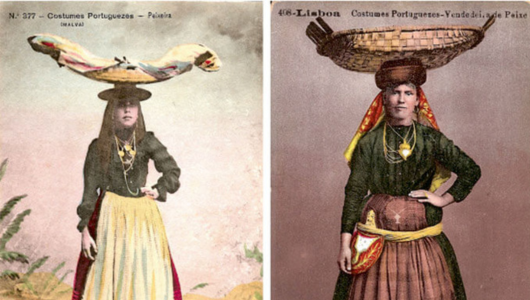
Photo by getLisbon
If the zona saloia was responsible for feeding Lisbon with products of the land, the middle work of food coming from the river and the sea was again done by women, even if they rarely went out in the fishing boats.
Along the Tagus and in coastal communities that supplied Lisbon, fishing was associated with a male job. Men went out to sea, often for days at a time, in conditions that were anything but romantic. But as soon as the boats approached land, women stepped in. They helped bring the boats ashore, repaired nets, sorted the catch, dried part of it, sold the rest and, later on, filled the workforce of canning plants. In the capital, this female presence crystallised into a very specific figure, the varina.
Originally, the term referred to women from Ovar (ovarinas), on the Aveiro coast, who came to Lisbon to sell fish. Over time, it became shorthand for the fish sellers of the city, who were women walking through neighbourhoods with a basket of fish on their heads and one hand on their hip, calling out the goods they were selling. The varinas are often referred to in fado lyrics, as they became such an integral part of the imagery of day-to-day Lisbon. Their look is iconic, but their job itself was brutal, as varinas were often up before dawn at the docks, running back and forth on narrow planks to unload not just fish but also coal, salt, vegetables and grain from the boats. From there, they would walk long distances through the city, carrying loads that easily reached 50 kilos, day after day.
For many families from humble fishing communities, these women were often the main breadwinners. While husbands or fathers risked their lives at sea or faced irregular work, varinas earned cash daily, selling in Alfama, Mouraria, Madragoa and other working-class neighbourhoods where people bought fish in small quantities, often for the meal of that day itself.
Today, the classic roaming varina has disappeared from Lisbon’s streets, surviving more in fado lyrics, statues like the one in Olivais, and nostalgic imagery than in daily life. But if you go to the fish sections of markets such as Mercado de Arroios, 31 de Janeiro or Benfica, you’ll notice that many of the faces behind the counters are still female. Some of the most respected peixeiras in Lisbon, carry on the same tradition in a fixed location rather than on the street. The basket may have been replaced by stainless steel and ice, but the authority is the same, as they are the ones who know well which sardines are actually from the Portuguese coast this week, which mackerel is worth grilling, and which fish is better suited for soup. This is why buying fish at a local market will always beat purchasing it from the regular supermarket, as at the market you can get way more tips for cooking if you want to, and quite often with fewer middlemen (or women) eating up the profits.
Conserveiras and other food factory workers
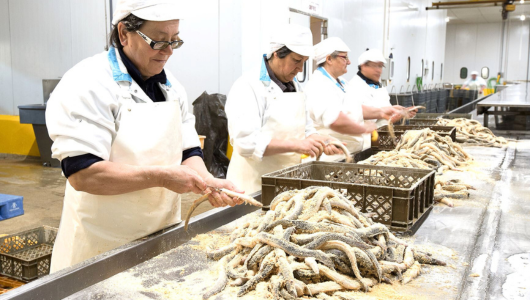
Photo by Estação Naútica da Murtosa
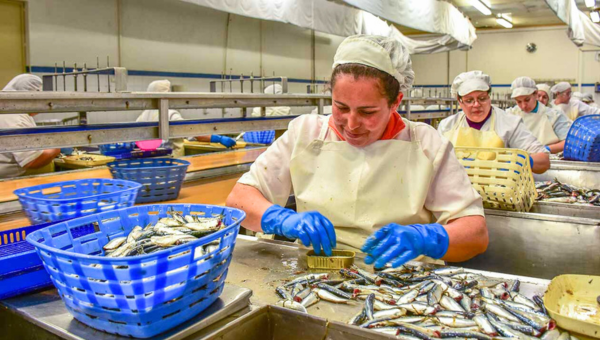
Varinas and peixeiras were the visible face of Lisbon’s fish supply, while factory workers were the ones who turned a fragile catch into something that could travel and sit on pantry shelves for months. From the late 19th century onwards, fish canning took off along the Portuguese coast. Matosinhos, Setúbal, the Algarve and parts of the Azores filled with conserveiras that cooked and packed sardines, tuna and mackerel in oil, tomato or brine. The overwhelming majority of the workforce in fish canning factories was and still is women. They gut, arrange and pack fish fast enough to produce tens of thousands of tins per day.
The tasks are repetitive and physically demanding, and the wages seldom match the effort, but for many coastal families these jobs translated into regular sources of income, something that other sea-related jobs like fishing, mostly done by men, could not guarantee. International estimates suggest that, across agrifood systems, women make up around half of all workers in food processing and services, and the share is even higher in segments like seafood processing.
Across the 20th century, women were also heavily present in vegetable and fruit processing, from tomato paste and canned tomato to fruit preserves and frozen peas. Portugal’s tomato industry, concentrated in Ribatejo and the centre-south, relies on seasonal production operators and sorting staff. As in similar plants across Europe, women have tended to dominate the lower-paid, line-based roles that involve sorting, trimming and packing. In Lisbon, we don’t see those factories, but we benefit from their outcome every time you open a can of tomate pelado or a bag of frozen green peas goes into a pan of soup or rice.
Cheese and dairy are also part of the story when we look at the role of women in food factory jobs, even though in this case their roles sit halfway between farms and actual factories. Traditional Portuguese cheesemaking is often described as women’s work, as while men look after the herds, women transform milk into cheese in the home or in small dairies. Today, industrial dairy processing is more mechanised and concentrated in big companies, but small and medium-scale cheese producers still frequently rely on female workers on the salting, turning, washing and wrapping lines, that is, for those repetitive, manual stages that give each cheese its final texture and characteristic edible rind.
Something similar happens with charcuterie and fumeiro, especially in the North and interior. The public image of cured meats often centres on butchers and smokehouses, but in many rural families it has long been the women who prepare the seasoning, marinating and stuffing sausages after the pig’s slaughter (matança do porco), and who monitor the long curing period in the smokehouse (fumeiro). This is not always factory work in the strict sense, but it is small-scale food production that still makes it to Lisbon’s counters via markets and specialized gourmet stores that privilege artisanal food products over mass-produced ones.
Lisbon itself has never been a major canning or cheese-making hub, but it has always been one of the main destinations for what other regions of the country produce. Such as the products we often take for granted over here, like the tins stacked in shops like Loja das Conservas and Conserveira de Lisboa, or the Portuguese regional cheeses and enchidos you find at traditional food stores like Manteigaria Silva.
Nuns and conventual sweets making
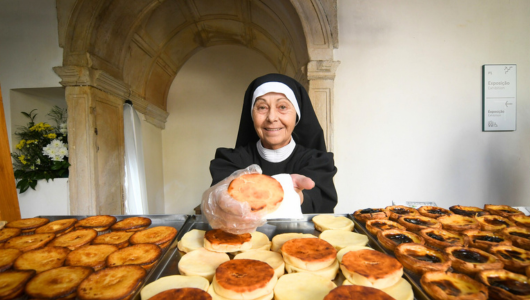
Photo by Diário As Beiras on Facebook
Across the country, and certainly in and around Lisbon, convent kitchens were some of the most important Portuguese pastry labs for what we now call doces conventuais. Inside cloistered communities, women with no public life visibility developed recipes that would later define the country’s dessert identity, featuring rich egg yolk sweets, almond-based cakes, syrup-drenched pastries and all the small sugary things we see for sale in pastelarias today.
Historically, convents used a lot of egg whites for practical reasons, from clarifying wine to starching habits and altar linens. Yolks were left over, and in a context where sugar from Brazil and later from other colonies became more available, it made sense not to waste them. Add access to high-quality almonds, spices and wheat flour through donations and rents, and you have the ideal conditions for intensive recipe development. Selling these sweets was a way to bring money into the convent.
Here in Lisbon, before the extinction of religious orders in the 19th century, the capital and its surroundings were full of convents, including Madre de Deus in Xabregas, São Bento, Santa Clara, Chelas, Odivelas and many more. Each had its own small repertoire of sweets, often with fiercely guarded recipes. When the liberal reforms forced many convents to close, recipes leaked out in different ways. Some nuns went to live with lay families and continued making their specialties there, and others sold their knowledge to emerging pastelarias. A few recipes were also written down and circulated and so, little by little, convent sweets left the cloister and entered the commercial life of the city.
The classic example everyone knows, even if they don’t think of it in these terms, is the pastel de nata. Whether you believe the version that ties it directly to the monks of the Jerónimos monastery in Belém or the broader story of custard tarts evolving from other custardy convent recipes, the logic is the same, involving egg yolks, sugar, flour and a very specific technique refined over years of repetition by women who never set foot in a professional kitchen as we define it today. Other sweets that Lisbon adopted from religious contexts include the rich sponge cake made mostly with egg yolks (pão de ló), dense baked egg-yolk puddings soaked in syrup (encharcadas), and thin egg crêpes rolled up and drenched in sugar syrup (trouxas de ovos). You’ll also find almond-heavy cakes such as toucinho do céu, a moist ground-almond loaf whose name literally means “bacon from heaven”, even if it no longer usually contains pork.
We could easily say that were mostly women who invented Portugal’s most famous sweets, doing so in enclosed spaces, working collectively, and more often than not anonymously. Interestingly, there is also a class dimension to all of this. While working-class women in Lisbon were stretching ingredients to make soup and stews at home, and others were working in markets or factories, convent sweets represented a more luxurious side of the female relationship with food. These were not everyday desserts, as they were heavy and labor intensive, usually reserved for festive occasions. If you visit Lisbon and walk past shops specializing in conventual sweets, such as Alcôa or Casa dos Ovos Moles, right downtown, you may want to think about the nuns who developed the recipes that we are still enjoying today.
The tasca cook
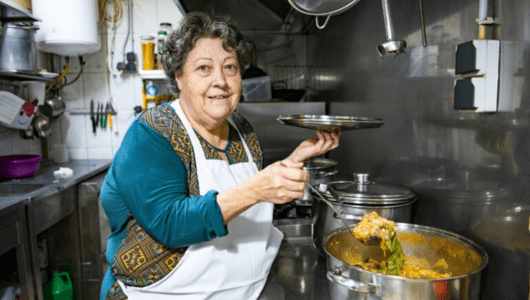
Photo by Jornal de Leiria
If you want to understand everyday Portuguese food in Lisbon, we would highly recommend that you visit a tasca, where the food served is very likely prepared by a woman. Many traditional tascas in Lisbon began as family businesses, with the wife cooking in the kitchen, while the husband served clients in the dining room.
Currently, in medium to high-end restaurants, we know who the chef is, including their first and last name, while maybe even being familiar with their face thanks to photos and interviews. In tascas, if you ask who’s doing the cooking, the answers are different, ranging from the owner’s wife or mother, to “a Dona Maria” or “a Dona Lurdes”. First name, sometimes with Dona, as a sign of respect, but rarely the full name as you would use when talking about a recognized chef, as a result of a close relationship nurtured daily these cooks and regular customers, as a result of a close relationship nurtured daily between these cooks and the regular customers who makes of this casual Tasca restaurants an extension of their home and feed their memories of their mothers or grandmothers’ comforting cooking, also as intimate and anonymous as these female cook who keep deciding what ends up on their plate that day, despite rarely being treated as a chef in their own right.
Most of these women did not go to culinary school. They learned to cook at home from mothers, grandmothers, other relatives, and then gradually moved that knowledge into a professional setting. That is exactly why tascas are still some of the best places to eat home-style food in Lisbon.
Running a tasca kitchen is far from simple, as service is usually concentrated in a short window at lunch and sometimes dinner, with a lot of people expecting to eat quickly and cheaply. The cook has to plan portions based on habit and experience, decide the daily specials (pratos do dia), and even prepare the home-made desserts that are always present in Portugal restaurants no matter how humble. On top of the technical side, there is the demand for consistency as regulars come expecting their favorite dishes to hit the spot as they might have anticipated.
There is also a gendered perception difference in how this work is valued based on the restaurant style: when in a contemporary restaurant, a male chef serves a refined version of a tasca classic, it is often framed as creativity or reinterpretation of tradition; When a female cook in a tasca has been cooking the original for forty years, it is described as just everyday food. Happens often, as well, that after service, many tasca cooks still go home to cook again, this time for family. One way or another, this is all a part of the unrecognized or taken-for-granted work that many women behind the stove still do in Lisbon today.
The senhora da cantina, the woman who feeds a crowd
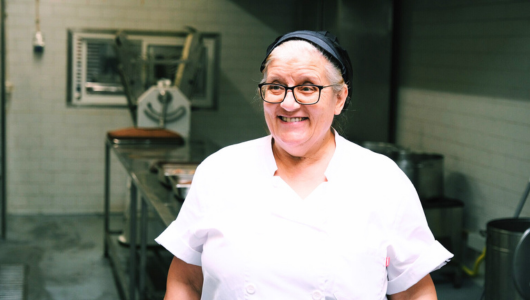
Photo by Universidade de Lisboa
If you grew up in Portugal, there’s a good chance one of the first hot meals you ate outside home was served on a tray, under fluorescent lights, by a senhora da cantina. For decades, these women have been a constant in Lisbon’s daily life, in school dining rooms and also catering to other public institutions such as hospitals.
Historically, the most emblematic version is the school canteen, as the cooks would be the ones also serving you on the line, as you’d pass by with your tray and they’d fill your plate. As public education expanded in the second half of the 20th century and more children started spending the whole day at school, hot lunches became a basic service. In most Lisbon schools, a small team of women arrived early, put on uniforms and hairnets, and made food for hundreds of kids on a tight budget and tighter schedule.
The menu has never been glamorous, but it’s good home-made food that’s fairly balanced. A school meal always includes a bowl of soup, a main dish with some form of protein (meat, fish, beans or eggs), carbs such as rice, potatoes or pasta, and a piece of fruit. Canteen cooks prepare things that aren’t too elaborate but that the younger ones recognize, while being filling and nutritious.
Factory kitchens and hospital canteens in and around Lisbon also relied heavily on women to cook for workers and patients. They also followed the same work patterns, with strict budgets and not a lot of time to prepare meals. But canteen cooks are more present in our mind and, for generations of Lisbon children, they became a daily presence. But, just like it happens in tascas, a senhora da cantina would be known simply as “a Dona X”, with a strong sense of familiarity.
Over the last decades, economic and logistical pressures have changed the role of canteen ladies. Many schools today hire catering companies that prepare meals in central industrial kitchens and then deliver them ready to serve or to be regenerated on location. This often means that a senhora da cantina is no longer a cook but a server and plate-assembler, and that the food feels less homely as compared to before. Yet, despite this trend, Portugal is frequently cited as a positive case when it comes to school meals that focus on hot food, the regular inclusion of soup and vegetables, fruit as standard dessert, and national guidelines that try to balance nutrition and budget. It’s far from perfect, but compared to countries where children often eat only sandwiches or ultra-processed snacks at school, the basic structure of a Portuguese canteen meal is relatively solid. At the same time, the work of senhoras da cantina is having to evolve as they’re now dealing with new expectations, such as allergies formally registered, vegetarian kids, parents asking about sugar content, and an increasing push for sustainability. Initiatives like ProVeg Portugal’s Prato Sustentável programme, for example, have started offering training and tools to school canteen teams so they can incorporate more plant-based options and adapt traditional Portuguese recipes using legumes and other sustainable protein sources. Whether they are cooking animal protein or more vegetables, what remains constant is the scale and the sense of responsibility, as a school canteen team might be responsible for hundreds of meals in just a few hours, and that is no small deal.
Food activists and educators
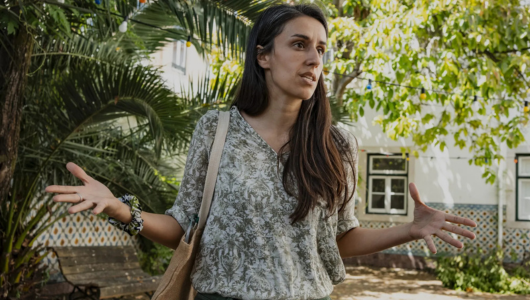
Photo by Mensagem de Lisboa
After generations of women cooking because they “had to”, Lisbon now has a growing group of women who still work with food, but also talk, write and organize activities around it. They are activists, educators and researchers who, in their own way, also have a say on how the city eats.
One of the clearest examples is Maria Antunes (pictured here), half of Kitchen Dates. She and Rui started by hosting vegan, zero-waste brunches at home, then opened what was described as Portugal’s first “restaurant without a rubbish bin”, a fully plant-based, low-waste spot in Telheiras. When the restaurant closed during the COVID-19 pandemic, they didn’t walk away from food. Kitchen Dates became a food literacy project, focusing on workshops, consultancy and a podcast showing how everyday choices can reduce waste and support local producers. We met Maria as a cook, but she is now also teaching people how to read labels, rethink convenience and see a pantry as a political space.
Something similar happens with Eunice Maia, founder of Maria Granel. Opened in 2015, Maria Granel is widely recognised as Portugal’s first organic bulk zero-waste grocery, with shops in Alvalade and Campo de Ourique. You go there to buy oats, beans or spices without packaging, and you also leave with ideas. Through talks, school visits and her book Desafio Zero, Eunice has turned her shop into a small hub for people who want to change how they shop, cook and store food at home, without the moral panic that often comes with sustainability discourse. In a quiet way, she is doing with jars and scoops what many women once did with old yoghurt pots and reused bottles in their kitchens, that is, stretching resources, avoiding waste, but now reaching a much wider audience.
On the more academic side, there are women who don’t necessarily cook for the public, but map and explain how Lisbon feeds itself. Urbanist Teresa Marat-Mendes has been studying the food system of the Lisbon Metropolitan Area, showing how localized food flows and urban agriculture can help make the metropolis more sustainable and socially fair. If you want to dive deeper into this, her article “How the food system of the Lisbon Metropolitan Area is structured” in the journal Cidades, Comunidades e Territórios is a good starting point. Geographer Isabel Madaleno has long researched urban agriculture and food sovereignty, including work on farming and other land uses in the Lisbon metropolis and how small urban plots contribute to feeding cities. Anthropologist Ana Isabel Afonso has co-authored surveys of urban gardens in the Lisbon region, looking at gardening as self-provisioning, leisure and activist practice. They are not serving lunch, but their research shapes how planners, NGOs and citizens think about where food comes from and who is involved in producing it.
At street level, activism also looks like opening the kitchen door to other stories. In Mouraria, Cozinha Popular da Mouraria, a project created by the journalist Adriana Freire, runs the Dia da Cozinha Aberta (Open Kitchen Day), a recurring event where new cooks, often migrant women, take over the stove to share food from “their side of the world”. These sessions are moments where recipes, personal histories and neighbourhood networks meet, promoting visibility, diversity and a sense of belonging.
Even in the more classic food tourism space, women are increasingly the ones interpreting Lisbon’s food culture for visitors. Many of our very own Taste of Lisboa’s guides, not to mention our founder Filipa Valente, are women who spend their days walking people through markets, tascas and pastry shops, explaining why certain dishes exist, who used to cook them, and how the city is changing around them. That might not sound like activism at first glance, but it is a form of food education that can contribute to correcting clichés, making space for lesser-known stories and connecting travellers with the real people behind the food they eat when they visit us in Lisbon. Ultimately, it’s about using the Lisbon food culture to give access to a deeper understanding of what makes Portugal and the Portuguese unique, and naturally feed common points among people from different cultures, facilitating togetherness and affection bonds that the acts of cooking, eating and sharing food foster so well.
Lisbon’s food has always been in the hands of women, and we’re here to celebrate that! For more stories like this, subscribe to Taste of Lisboa’s newsletter and follow us on Instagram.
Feed your curiosity on Portuguese food culture:
8 Portuguese Female Chefs You Should Know
A guide to tea culture in Portugal
How the Portuguese changed the way the world eats
Real people, real food. Come with us to where the locals go.
Signup for our natively curated food & cultural experiences.
Follow us for more at Instagram, Twitter e Youtube