
How the global journey of feijoada began in Portugal
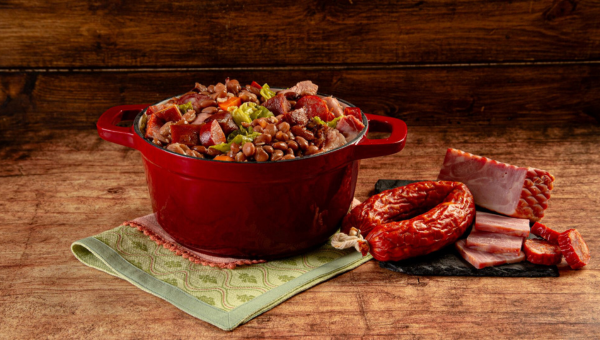
Whether they make it with red or white beans, many Portuguese grandmothers swear by their beans and pork stew, that is, feijoada. Around the world, though, when people hear the word feijoada, they think of Brazil, where it’s celebrated as a national dish. But what few may realize is that this beloved comfort food actually traces its roots back to Portugal, and that raises an uncomfortable historical question: how could Portugal have invented feijoada if there were no beans in Portugal when the recipe supposedly began?
Before the 16th century, there wasn’t a single feijão growing on European soil. Beans, the New World varieties that we now associate with daily Portuguese cooking, are native to the Americas. They only reached the Iberian Peninsula after Portuguese and Spanish ships returned from their Atlantic voyages, carrying not just gold and stories, but plants that would forever change our entire diet, such as tomatoes, potatoes, maize, and, of course, beans. Until then, the Portuguese pantry relied on Old World legumes like broad beans (favas), chickpeas (grão-de-bico), and lentils (lentilhas). So, if feijoada depends on feijões, how could it possibly predate their arrival?
This is where the story gets interesting. While the beans themselves were a New World novelty, the idea behind feijoada, that is a slow-cooked stew combining pulses with pork and vegetables, was centuries old by the time beans even reached Portugal. Its roots trace back to the Roman and medieval traditions that spread across Europe, where one-pot meals were a practical way to feed large households and make the most of scarce ingredients.
Feat photo by Primor
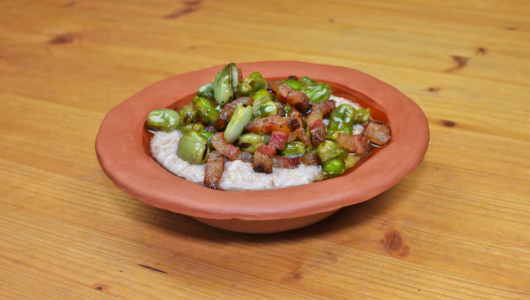 Photo by Historical Italian Cooking
The Romans already prepared lentil or bean stews enriched with bits of salted pork, a habit that endured through the Middle Ages. One of the most common was fabacia (pictured above in a modern interpretation), mixing broad beans with pork. As cooking evolved, these hearty stews became staples of European peasant cuisine, as they were nourishing, economical, and super adaptable. In Spain, this tradition became olla podrida; in France, it was cassoulet; and in Portugal, it took the form of cozido, all generous pots of meats, sausages, and legumes simmered until everything melded into one comforting dish.
So, long before the first American beans ever reached Iberia, Portuguese cooks already understood the principle that defines feijoada, which is basically slow cooking as a way to stretch resources and transform modest ingredients into something very flavorful. When beans arrived from the New World in the 16th century, they didn’t create a new dish as such, they simply used them to continue preparing food following this traditional European way, but now replacing chickpeas or fava beans with the softer and creamier legume that ended up changing the texture of the dish, but not its essence.
That’s why today, when we ask “where did feijoada really come from?”, we’re not only talking about a recipe. We’re also talking about the history of Portuguese exploration, colonization, and exchange, the way an idea born in one continent crossed oceans, adapted to new lands, and came back transformed. And as we’ll see, that same stew would later become Brazil’s national dish, find cousins in Africa, and still continue to simmer proudly in Portuguese kitchens centuries later.
When did beans arrive in Portugal?
To understand feijoada, we first need to understand its star ingredient, the humble bean. Because, despite how natural it feels to scoop up feijão with rice today, beans are not originally from Portugal, or even from Europe. They’re native to the Americas, and they only reached Portuguese kitchens after our sailors had already crossed the Atlantic.
Before Columbus and Pedro Alvares Cabral rewrote global trade routes, Portuguese tables looked very different. The medieval pantry was built on Old World legumes like broad beans, chickpeas, lentils, and peas, all of which had been around for thousands of years. These were the backbone of peasant diets and the base for countless soups and stews. When chroniclers from the 14th and 15th centuries mention bean stews, they’re talking about favas, not the feijões we know today.
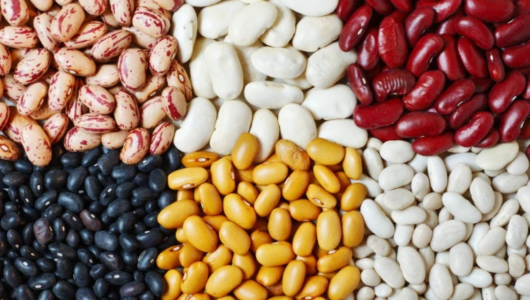 Photo by IndexBox
So, when did beans arrive? Historians and botanists agree that phaseolus vulgaris, the common bean species that includes red, black, and white beans, reached Iberia in the early 16th century, shortly after Portuguese and Spanish explorers encountered them in the Americas. From there, the new crop spread astonishingly fast. Portugal’s maritime network allowed beans to circulate between Brazil, Africa, and Asia, but also back home, where local farmers quickly realized that these newcomers thrived in Iberian soil and climate. Within a few decades, beans became a pantry staple, sometimes even replacing favas in traditional recipes.
Interestingly, some of Portugal’s first cookbooks don’t mention feijoada at all, but they do mention stews where beans appear alongside pork, smoked sausages, and cabbage. These early references suggest a gradual blending of traditions, with the old European idea of a cozido meeting the new ingredient from across the ocean. By the 17th century, feijões had fully entered the Portuguese vocabulary, both linguistically and culinarily. The New World bean had become so Portuguese that by the 18th century, you’d be hard-pressed to find a village that didn’t have its own way of cooking it.
The paradox, then, begins to dissolve. Portugal didn’t invent feijoada out of beans, but it invented the idea of feijoada, it being a rustic, slow-cooked stew meant to stretch scraps, nourish families, and celebrate abundance when there was very little of it. Once beans arrived, they simply took over the starring role, turning an old tradition into something new, and also into a dish ready to travel the world!
European stew traditions and the conceptual ancestors of feijoada
Before feijoada ever had a name, Portugal was already a land of slow-cooked stews. Across medieval Europe, cooks were masters at turning humble cuts of meat and legumes into dishes that could feed entire families, and the Iberian Peninsula was no exception. Spain had olla podrida, France had cassoulet, and Portugal had cozido, a generous pot of pork, sausages, vegetables, and pulses simmered until every ingredient lent its flavor to the broth. In fact, we defend that cozido à portuguesa is Portugal’s national dish, as it is so incredibly representative of Portugal’s food culture across centuries.
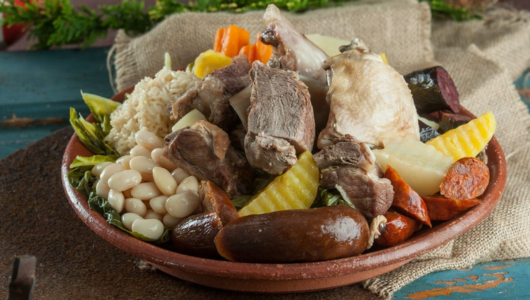 Photo by Teleculinária
Cozido and its regional cousins were reflections of rural life, where nothing went to waste and every piece of the animal found its place in the pot. Replace those chickpeas or broad beans with the New World beans that arrived in the 16th century, and you have the foundation for what would later be called feijoada.
What the beans did was not create something entirely new, but rather give a name, and a new texture, to a cooking method that Portugal already understood by heart. In this sense, feijoada was less an invention than an evolution, a local expression of a European idea that had already crossed countless borders before it ever reached Brazil.
Portuguese feijoada and the regional variations of a national dish
If there’s one thing the Portuguese agree on, it’s that feijoada should be hearty enough to put you to sleep after lunch. Everything else is up for debate. North to south, each region adds its own touch to the dish, swapping bean colors, meats, and even ingredients that would make another cook question the recipe. These variations of recipes show us how feijoada adapted to local landscapes, and how it mirrors the social geography of Portugal itself.
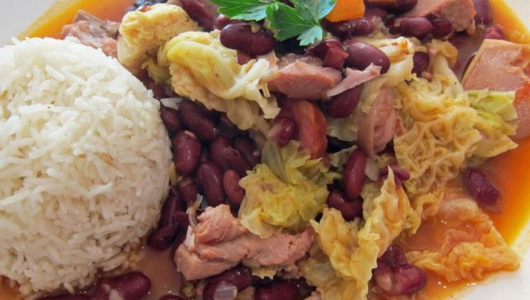 Photo by Gastronomia e Vinhos
The most iconic version is feijoada à transmontana (pictured above), from Trás-os-Montes in the country’s rugged northeast. Here, the winters are long and cold, and the pork culture runs deep. This is a land of smokehouses and cured sausages (enchidos), so naturally, the local feijoada comes loaded with chouriço, morcela, salpicão, and all the bits of the pig that rarely leave the region. Red beans are the base, simmered until thick and rich, with cabbage adding a hint of green freshness. Traditionally, this feijoada is eaten during the matança do porco, the annual pig slaughter, when nothing goes to waste and the village gathers to celebrate.
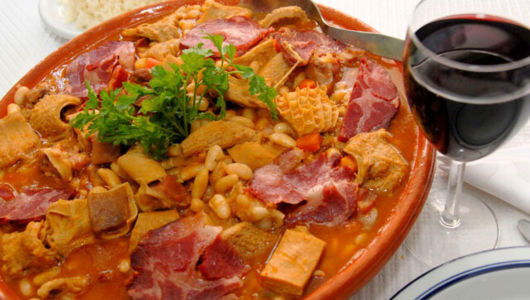 Photo by Câmara Municipal da Póvoa de Varzim
Move west toward the coast and you’ll find feijoada poveira (pictured above), from Póvoa de Varzim, a fishing town near Porto. Here, the stew lightens up a little and makes good use of white beans to replace the red ones.
Further south, feijoada à portuguesa takes a more standardized form, the one you’re likely to find in Lisbon or Alentejo eateries. It usually includes pork ribs, bacon, sausages, and sometimes a few slices of beef, stewed with carrots, onions, and red beans in a broth flavored with tomato. It’s often served with rice and farinheira sausage, whose smoky sweetness offsets the saltiness of the pork. Feijoada often appears listed as a dish of the day (prato do dia) in typical eateries all over Lisbon, so thankfully you do not need to wait for a special occasion to taste it (suggestions on where to try it below).
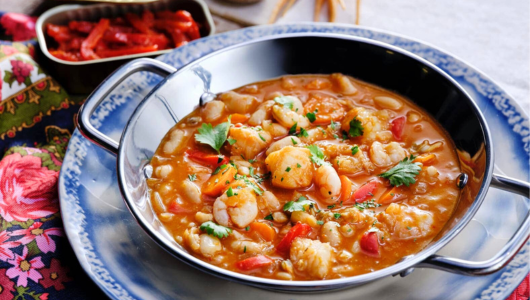 Photo by Ruralea
Feijoada eventually made its way to the coast, trading pig’s feet for tentacles and smoke for the scent of the sea. Feijoada de marisco (see photo above) is a well known reinterpretation, a dish where clams, prawns, and even mussels swim in a tomato based broth perfumed with bay leaf, coriander, and a splash of white wine. Lighter and more aromatic than its meaty cousins, it’s popular from Setúbal to the Algarve, often appearing on restaurant menus as a summer alternative to the traditional winter stew. But perhaps even more emblematic of Portugal’s coastal creativity is feijoada de choco (see photo below), made with tender cuttlefish slowly simmered with white beans, onion, garlic, and just enough paprika to tint the sauce a deep orange. It’s especially beloved around the Sado and Tejo estuaries, where fresh cuttlefish is abundant and cooks like blending sea and soil in one pot.
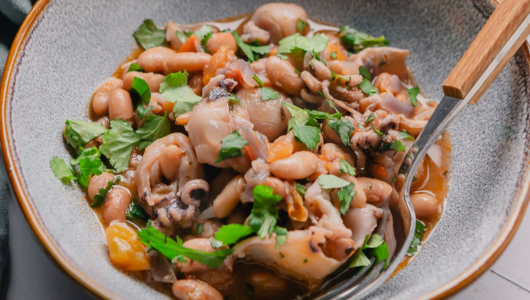 Photo by Continente Feed
These Portuguese variations of feijoada show how a simple bean stew can end up absorbing regional identity. Together, they show that feijoada isn’t just about beans and pork and, more than a recipe per se, it’s a concept.
From Portugal to Brazil: the colonial reinvention of feijoada
When feijoada crossed the Atlantic, it changed continents, and it changed meaning. What had been a rustic, regional Portuguese stew became a symbol of Brazil’s national identity, wrapped in stories of colonial life, slavery, and resilience. But the familiar narrative that feijoada was “born in Brazil” doesn’t tell the whole story, as we know by now that its origins actually reach back to Europe.
As Portuguese settlers and traders established colonies in Brazil, they brought with them language and religion. Furthermore, they also carried culinary habits, including pork preservation, the use of smoked sausages for flavor, and the love of long simmered stews thickened with legumes. In Brazil, these traditions met new landscapes and new ingredients such as black beans, cassava flour, and tropical produce. It was only natural that the Portuguese concept of cozido or early feijoada found a new life here, adapted to local realities.
Then there’s the other story, the one every Brazilian has heard at least once. It says that feijoada was invented by enslaved Africans on sugar plantations, who were given scraps of pork by their masters and cooked them with black beans, creating a dish of ingenuity and resistance. It’s a powerful narrative, one that resonates emotionally and culturally. But historians have pointed out that it’s more legend than fact.
For one thing, black beans (feijão preto), now iconic in Brazilian feijoada, were not a slave food. They were a staple crop eaten across all social classes in colonial Brazil. And the pork cuts often said to be “leftovers”, such as ears, trotters, tails, were considered delicacies in European cookery, not waste. In Portugal, these parts were already part of festive dishes like cozido. So rather than being born from oppression alone, feijoada in Brazil was likely a fusion of Portuguese techniques, African culinary knowledge, and local ingredients.
 Photo by Sabores Ajinomoto
The first written reference to feijoada à brasileira dates back to the early 19th century (1827, in Recife), where it appeared not in the context of plantation kitchens but in an urban restaurant advertisement. By the mid 1800s, it was already a fashionable dish in Rio de Janeiro, served in taverns and cafés to the middle and upper classes. Over time, it evolved into the version we know today, featuring black beans stewed with pork and beef, served with rice, sautéed collard greens (unlike the Portuguese version which includes cabbage mixed in with the beans, but in Brazil they serve the greens as a side), seasoned cassava flour (farofa), a tangy mix of tomatoes, onions, bell peppers and herbs known as vinagrete, and orange slices, a complete meal that represents Brazil’s mix of European, African, and Indigenous influences.
Seen this way, feijoada wasn’t an invention of a single group or moment, but the result of centuries of cultural exchange, and a delicious edible expression of Brazil’s beautiful social complexity. It carries Portuguese culinary DNA, African knowledge of stewing and seasoning, and New World ingredients that gave it its distinctive look and flavor. What began as a European idea became, in Brazil, a shared identity, through a dish that unites the entire nation.
Feijoada in Lusophone Africa and the wider Portuguese speaking world
Wherever the Portuguese went, feijoada found a new version. The dish travelled along the same maritime routes that carried sugar, spices, and faith, adapting to local climates and ingredients in Africa, Asia, and beyond. Like the Portuguese language itself, feijoada became a global dialect, instantly recognizable, yet never quite the same from one place to another.
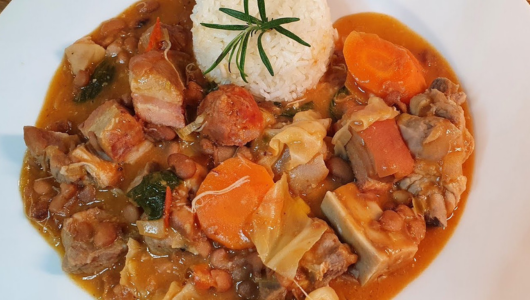 Photo by Receitas da Tia Gucci on Youtube
In Angola, feijoada reflects both its Portuguese roots and the availability of ingredients. The Angolan version, also known as feijoada de Luanda (pictured here), often blends red or brown beans with pork, but it can also include dried fish, cassava leaves, or palm oil, ingredients that link it to local stews such as moamba or calulu. It’s a dish that blurs boundaries, served with rice or funge, a soft cassava porridge that replaces the rice typical of Portuguese tables.
In Mozambique, the dish leans toward the sea. Feijoada de camarão and feijoada de choco are popular along the coast, where beans mingle with prawns or cuttlefish, often seasoned with coconut milk and spicy piri-piri. It’s a clear example of how Portuguese culinary methods such as slow cooking and the layering of flavors, intertwined with local tropical ingredients to create something distinct.
Cape Verde’s version, sometimes called feijoada cabo-verdiana, feels closer to home, as it’s made with red beans, pork, cabbage, and sometimes sweet potato or squash, reminding of the Portuguese mainland, but still making use of the archipelago’s very own ingredients. In Guinea-Bissau and São Tomé, cooks often prepare bean stew with fish (feijoada de peixe), a creative adaptation for regions where meat was historically scarce but the ocean was never far away.
Further east, in Timor-Leste, feijoada à timorense keeps the same Portuguese soul while embracing local flavors. It’s made with red beans, pork, and smoked sausages, but cooks often add regional touches like papaya leaves or local spices. Served during family gatherings and holidays, it’s another example of how the Portuguese idea of a bean and meat stew took root and adapted in distant lands.
Across all of these regions, what unites feijoada isn’t a fixed list of ingredients but a shared concept that involves one pot, slow heat and, generally speaking, communal eating. For better or worse, whether it’s seasoned with paprika or palm oil, served with rice or cassava, feijoada continues to express the essence of Portuguese colonial exchange.
Where to eat feijoada in Lisbon
If you want to understand how feijoada connects Portugal to the rest of the world, Lisbon is the place to do it. In just a few neighborhoods, you can try versions that reflect the country’s regional traditions as well as the influences that came back from Brazil and Africa.
Try a traditional Portuguese style feijoada at:
Adega da Tia Matilde
A down-to-earth eatery where locals come for honest home-style cooking. Their feijoada à transmontana is the real deal, featuring red beans, smoked sausages, and tender pork cuts cooked until the sauce clings to the spoon. Rustic and deeply comforting, but keep in mind that the dish is considered special and it’s usually only available on Fridays, served during lunch hours.
📍Rua da Beneficência 77, 1600-017 Lisbon
www.instagram.com/adegadatiamatilde
Try feijoada de choco at:
Sant’Avó
This contemporary restaurant with a lot of Portuguese soul, prepares an incredible feijoada with cuttlefish, which is enriched with some prawns too. Served with white rice to soak up all the juices, makes for a wonderful local meal, to be enjoyed in the heart of the traditional neighborhood of Graça.
📍Largo da Graça 105, 1170-165 Lisbon
If your budget allows, treat yourself to a seafood feijoada at:
Restaurante Pinóquio
This marisqueira prepares one of the most luxurious versions of feijoada you are likely to taste around Lisbon, featuring prawns, clams and lobster. Perhaps not the most traditional, but it clearly showcases how feijoada is a versatile and delicious concept.
📍Praça dos Restauradores 79 80, 1250-188 Lisbon
Sample the Brazilian national dish, feijoada brasileira, at:
Boteco Dona Luzia
Served exclusively on Friday, Saturday and Sunday, feijoada at this restaurant shows how this dish evolved from something humble into a very festive meal option. Here it is served as Brazilians like it, with black beans, toasted farofa, sautéed greens, white rice, and the customary slice of orange to help balance out the fat.
📍Avenida 5 de Outubro 36d, 1050-053 Lisbon
How did feijoada evolve once it traveled to Africa? Taste it for yourself at:
Jango Taste of Africa
Looking for a feijoada with lots of African soul? Perhaps you didn’t think eating a São Tomé and Príncipe style feijoada was in the cards during your travels in Lisbon, but if you visit this pan-African restaurant you can sample their guisado de feijão, which is a mouthwatering example of how feijoada evolved once the Portuguese concept was taken to several parts of Africa.
📍Centro Comercial Colombo, Av. Lusíada, 1500-676 Lisbon
Discover a taste of Angolan feijoada near Lisbon at:
Marimba
On Thursdays, Marimba in Loures, a town in the Great Lisbon area, serves feijoada à moda Angolana, that is, Angola’s take on feijoada. Unlike the Portuguese version which relies mostly on pork cuts, Angola’s take on the dish may include pork but also features pieces of chicken, thus making for a somewhat lighter version of this dish.
📍Av. Descobertas 47, 2670-387 Loures
 Photo by Gal
Following a plant-based diet? Eat vegan feijoada at:
Gal Café
This modern café with Brazilian management serves snacks and main meals during lunch hours. On the 3rd week of the month, they prepare a Brazilian style feijoada vegana (pictured above) the Lisbon vegan community raves about, and which is prepared with home-made plant-based chouriço, banana farofa, rice, greens, and orange.
📍Rua do Forno do Tijolo 54A, 1170-172 Lisbon
www.instagram.com/galcafe.anjos
If you’d like to discover more stories like this, where food, culture, and history meet, follow Taste of Lisboa on Instagram or subscribe to our newsletter. We’ll keep sharing with you the best of Lisbon’s edible heritage.
Feed your curiosity on Portuguese food culture:
The origins of vindaloo: how the popular Indian dish actually came from Portugal
Portugal’s best rice dishes (and where to eat them in Lisbon)
Portugal’s best corn dishes (and where to eat them in Lisbon)
What Portuguese people usually have in their pantry
The ultimate guide to olive oil in Portugal
Real people, real food. Come with us to where the locals go.
Signup for our natively curated food & cultural experiences.
Follow us for more at Instagram, Twitter e Youtube